

Roofing and energy
Rooftop solar in Poland: what to check about electricity use and billing before installation
The financial return on rooftop solar depends on how much electricity you use on site, when you use it and how your supplier credits exports. To assess a system, look beyond the rated output of the modules. The condition of the roof, installation costs and access for maintenance matter too. Review the electricity bills and roof covering together so you can size the system for the building. Generation may peak at midday when the house uses little electricity. The surplus goes to the grid. In the evening, you buy electricity under the terms of your contract. Multiplying the entire annual output by the retail electricity price overstates the savings if you export part of that output at a lower value.
In this article
How does generation translate into savings?
A calculation based on generation alone overlooks the difference between the value of exports and the cost of imports. Some charges on your bill will also continue after installation.
Start with your electricity consumption profile. Check bills, appliance running times and any planned changes, such as switching to electric heating. Distinguish measured demand from assumptions. Ask the installer what figures they used. Systems of the same capacity can produce different financial results in two similar homes. A forecast should show how much the result depends on the assumed electricity prices. Ask for a second calculation with different prices to see how much of the return comes from using your own electricity and how much depends on the value assigned to exports.
How is exported electricity credited under net billing?
Under Polish net billing, exports are assigned a monetary value according to the applicable settlement rules. The resulting credit is used towards electricity purchases. A kilowatt-hour exported today does not entitle you to draw a kilowatt-hour later. Check which parts of the bill the credit covers and how long it remains available.
The terms may depend on when the system began generating electricity and on the billing option chosen. A neighbour’s arrangement may differ from the one available for a new installation. Check your current contract, tariff and supplier information. In the financial estimate, allow for the possibility that exports at different times may have different values.
How can you use more of your solar power on site?
Self-consumption means using solar electricity on site as it is generated. Scheduling appliances, water heating or electric vehicle charging can increase it. Start with the controls you already have and choose times that work for the people using the building.
Base changes on actual needs. Running an appliance unnecessarily to absorb surplus power saves no money. A larger array may bring little extra benefit if much of its output is exported. Allow for seasonal differences too. High summer generation tells you little about how much of the heating demand solar power can meet in winter.
When is it worth comparing a battery option?
A battery lets you use some of your solar electricity later. The calculation needs to account for its purchase price, power rating, usable capacity and losses, as well as how it will operate and what the warranty covers. The amount of energy available to the household each day depends on actual charging and discharging. The nominal capacity alone cannot tell you that figure.
If backup power matters to you, ask which circuits will work during a grid outage. A battery needs a suitable system layout and configuration to provide backup. Compare the system with and without a battery. List assumptions about future prices and subsidies separately so the cost of storage itself is clear.
How should a metal roof be prepared for solar modules?
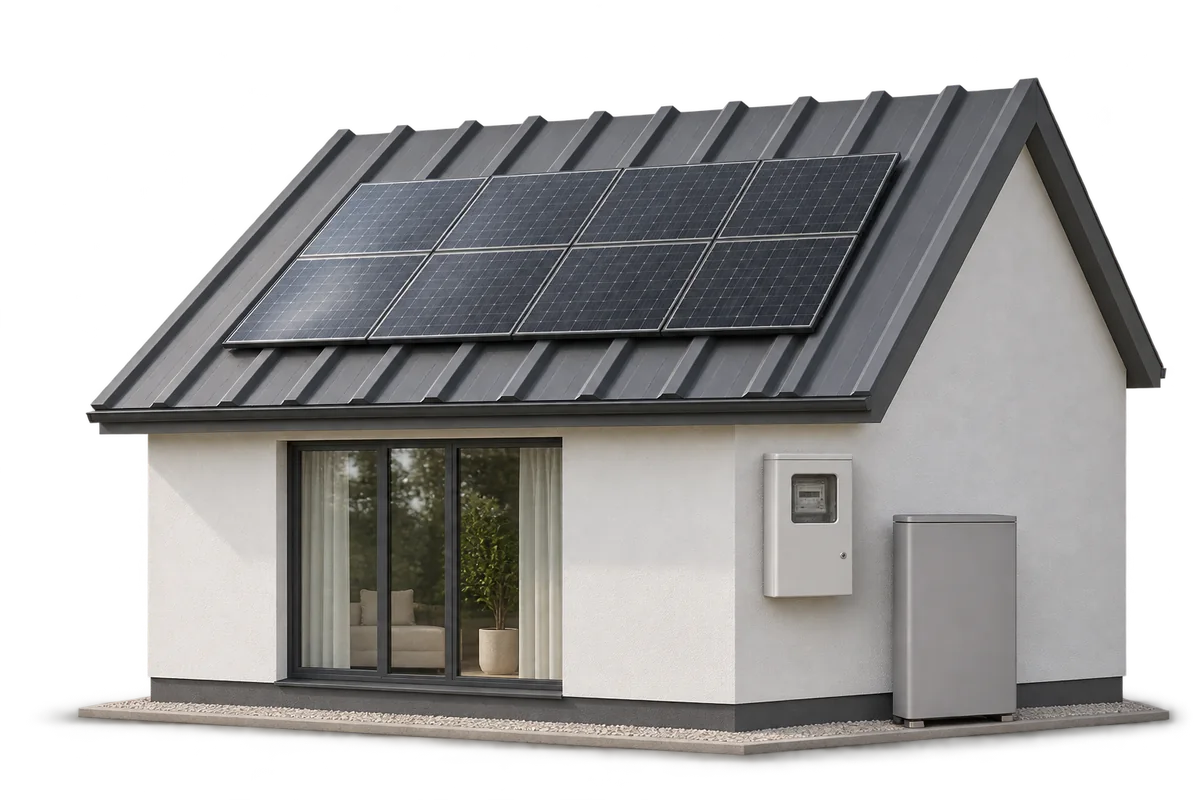
T18 or T35 trapezoidal steel sheets, tile-effect metal roofing and insulated roof panels need fixings suited to the particular covering. The design must consider the weight of the modules, wind, snow, the supporting structure and existing connections. The bracket spacing should be calculated for the actual roof slope and construction.
If the roof covering is worn, price the repairs before installing solar modules. Plan penetrations, seals and cable routes, and retain access to gutters and roof equipment. The fixings must preserve the protective coating and allow water to drain. Check the warranty terms for the roof covering as well.
How can you compare payback estimates?
Ask for the full cost of design, installation, protective devices, commissioning and any required approvals. Check whether roof work and changes to the electrical installation are included. The forecast should show generation, self-consumption and exported electricity separately. Allow for maintenance and possible changes in how the building is used.
Compare two or three scenarios with explicit assumptions. For example, use a cautious case, one based on current conditions and one reflecting a planned increase in consumption. The estimates help you make a decision. Future bills will depend on actual use, prices and contract terms. Select the system to suit the building, the people who live there and the condition of its roof.