

Sandwich panels
Choosing sandwich panels for thermal insulation and building protection
A building envelope must limit heat loss and meet the building’s safety requirements. When choosing sandwich panels, consider those two tasks together. PIR provides good thermal insulation with a relatively thin core. Mineral wool may be preferable where fire performance is a priority. Check the properties of the particular panel, the joint detail and the intended use. A heated warehouse, a cold store and a hall without continuous heating have different needs. The internal temperature and humidity, the materials stored and the requirements for the wall or roof all matter, as do wind loads and exposure to the elements. Without this information it is difficult to judge which panel suits the building.
In this guide
Start with how the building will be used
Set out the requirements for walls, roof and internal partitions separately. They need not all have the same core or panel thickness. Where different panels are justified, design their junctions in advance. Combining products on site without checking the joint profiles and details makes it harder to achieve a weathertight envelope.
Where does a PIR core offer an advantage?
The foam’s low thermal conductivity reduces the panel thickness needed for a given thermal resistance. This is useful where space is limited or junctions are difficult to detail. Look first at the thermal transmittance (U-value) of the finished panel, then at the performance of the complete wall or roof. The figure for the core material alone does not account for all heat losses.
Keep the insulation continuous at plinths, door openings and corners. Fasteners and the supporting frame can also affect heat loss. A thicker panel cannot make up for a gap in the insulation, so review the junction details when choosing the thickness, before obtaining prices and ordering components. Airtightness is just as important: warm, moist air passing through a leak can cause local condensation.
When should you consider a mineral wool panel?
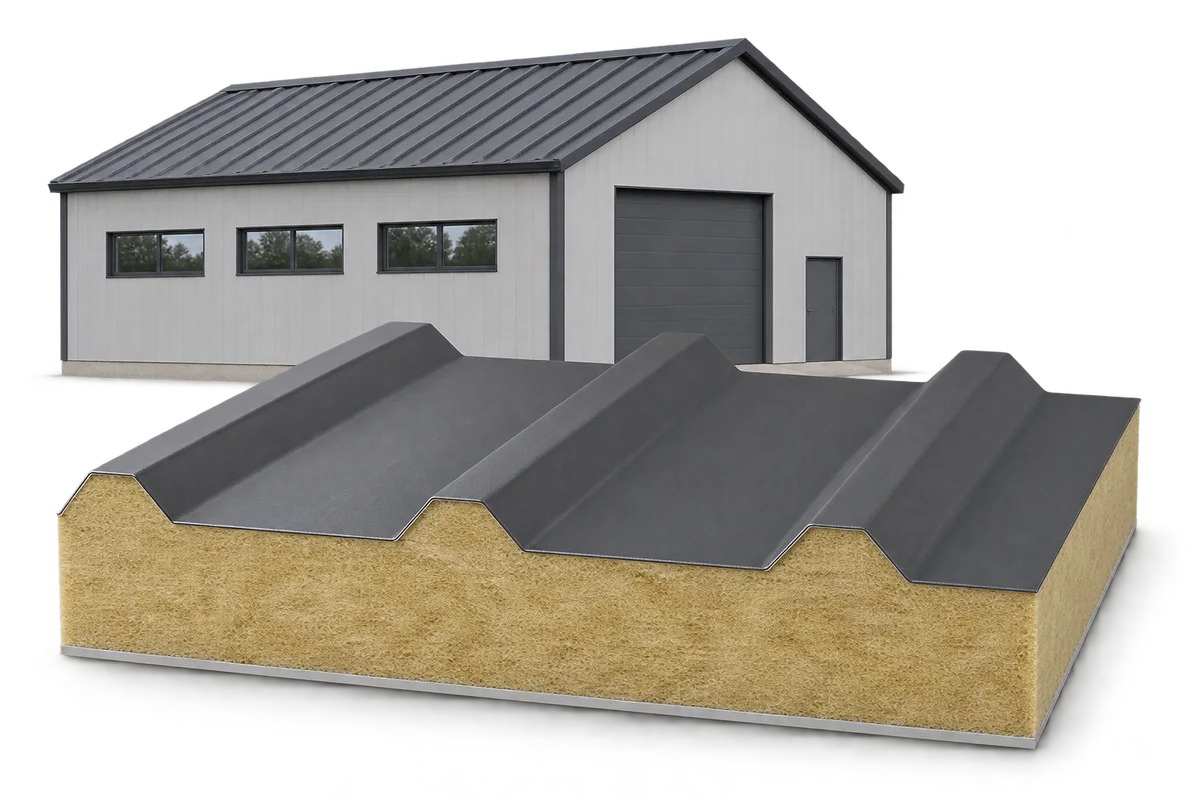
Mineral wool cores are used in walls and roofs with stringent fire performance requirements. Suitable panel assemblies can achieve high fire resistance ratings. These ratings are not the same for every mineral wool panel: they depend on the panel construction, thickness, joints and fixing conditions.
The choice of core also affects panel weight and how installation is organised. Mineral wool usually needs a thicker core than PIR for comparable insulation. Compare complete wall or roof assemblies meeting the same requirements. A comparison based solely on the panel price per square metre can overlook the supporting structure, transport and fixings.
How to check declared fire performance
Reaction to fire describes how a product behaves when exposed to fire. Fire resistance describes how long a particular wall or roof assembly maintains specified functions, as demonstrated by testing and classification. These are different properties. A metal facing does not make every core enclosed between two steel sheets non-combustible.
Read the field of application for the declared classification. It may specify panel orientation, maximum span, types of support, seals and fixings. A specially designed joint only performs as intended if it is installed as documented. A result for one wall cannot be applied to any roof made of a similar material.
Keeping out water and air starts at the joints
Factory-finished surfaces save time, but the joint between panels still needs care. A joint that is not fully engaged or has a damaged seal can let in water and moist air. The order of installation matters at corners and around openings. Fitting a flashing over the outside afterwards will not reliably correct every fault.
On a roof, maintain the specified pitch and form the overlaps correctly. At the foot of a wall, pay particular attention to the plinth, which is exposed to splashing water and impact. Choose coatings separately for external and internal conditions. In damp or chemically aggressive interiors, suitability matters more than colour. Match the cleaning method to the coating too: harsh chemicals or a powerful water jet aimed into a joint can shorten the life of the envelope.
How to compare quotations on equal terms
List the required U-value, fire performance, span, facing thickness and coating types. Include the panel layout and a full schedule of flashings and fixings. This lets you compare quotations for assemblies that perform the same tasks. Claims about superior insulation or safety are no substitute for these figures. Include warranty terms and the requirements for subsequent inspections.
Keep the delivery documents that identify the exact panel supplied. At handover, inspect the joints, service penetrations and surface condition. A sandwich panel can provide both protection and insulation, but it achieves its intended performance only as part of a properly installed envelope. The details need as much attention as the core.