

PIR insulation
Can PIR insulation be combined with mineral wool, EPS or XPS?
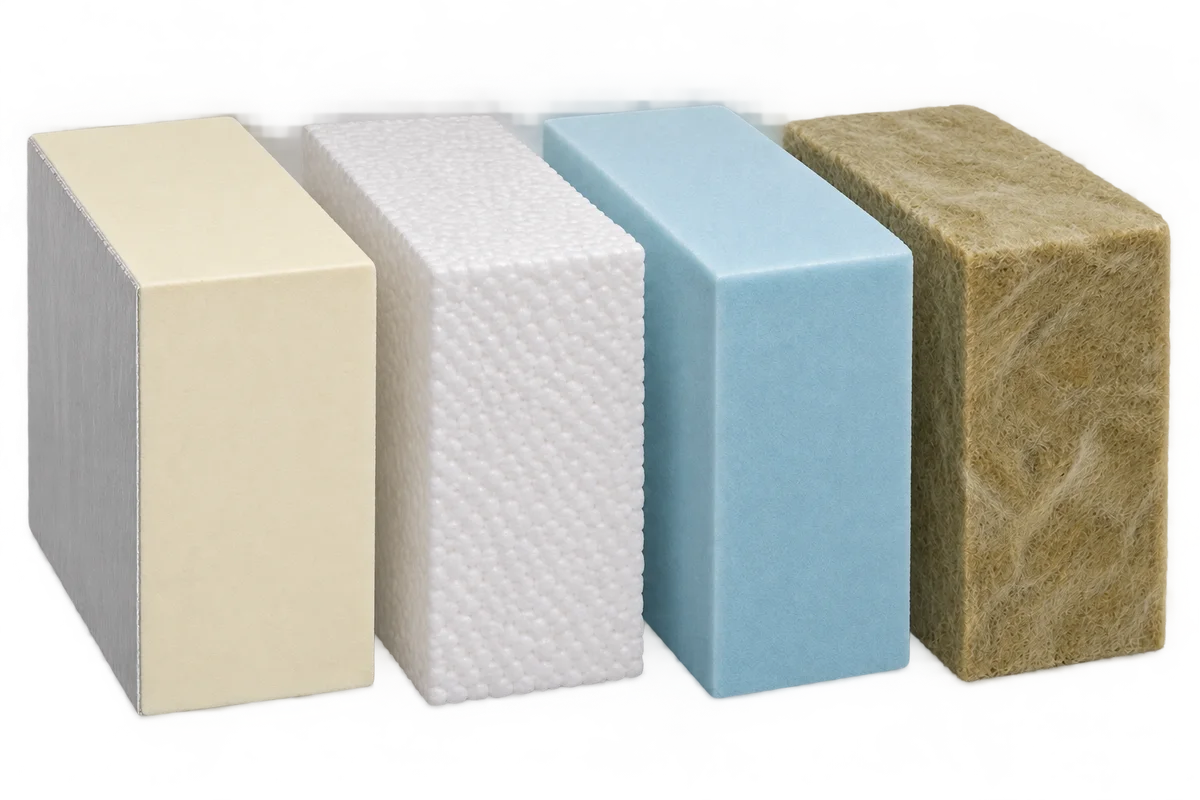
Different insulation materials can work together in one building element when each solves a specific problem. PIR can keep the build-up thin, mineral wool can contribute to fire protection or acoustics, and XPS suits certain applications exposed to moisture and compressive loads. The order of the layers, how they interact and the details of their installation determine whether the combination works. Adding their thermal resistances is not enough. In a roof retrofit, serviceable insulation can often stay in place while a new layer improves the whole assembly. In a floor, thermal insulation and a resilient layer for impact sound have different jobs. Combining materials is a design decision.
In this guide
When does combining materials make sense?
Using up materials left over from unrelated work is not a sufficient reason for combining them.
Define the problem and check the existing construction first. Is the issue insufficient thermal resistance, a gap at a rafter, poor acoustics or limited headroom? The answer helps establish where PIR should go and how thick it needs to be. Otherwise, extra material may have little effect or may stop a previously sound assembly from drying out.
How do the layers compare thermally?
For a homogeneous layer, divide its thickness in metres by its thermal conductivity to find its thermal resistance. In a simplified model, the resistances of successive layers can be added. This does not account for rafters, fixings or other thermal bridges. Calculating the U-value of the whole element requires its actual construction and the applicable calculation conditions.
For example, 100 mm of PIR with a thermal conductivity of 0.022 W/(m·K) gives a calculated layer resistance of about 4.55 m²·K/W. This is useful when depth is limited, but it is not a value for all PIR products. Boards with different facings can have different declared values. Use the data for the exact variant specified for the work.
What should you check in a roof with PIR and mineral wool?
A continuous layer above the rafters can reduce the effect of the timber bridging the insulation between them. Some designs place boards on the room side instead. In each case, check the contribution of each layer and the temperature profile through the roof. No single ratio of insulation thicknesses is safe for every roof.
Pay particular attention to the vapour resistance of the facings, airtightness and the ability of the timber to dry. Aluminium foil can strongly restrict vapour diffusion and changes the moisture behaviour of the assembly. Do not add further vapour-tight layers without a heat and moisture assessment, particularly if the type of underlay beneath the roof covering is unknown.
How can PIR be combined with EPS or XPS?
In a floor, different layers can help achieve the required build-up height and load capacity, but together they must provide stable support for the floor finish. Check the long-term deformation of each layer. A strong board on top cannot prevent excessive compression of a weaker layer below. Consider how loads from furnishings and equipment are distributed.
Flat roof systems can incorporate different insulation materials, including tapered layers. The design and the system documentation must confirm their compatibility. Do not apply the principles of a conventional warm roof unchanged to an inverted roof. Insulation above the waterproofing faces different moisture conditions and must be selected accordingly.
Do the properties of the materials simply add up?
A mineral wool layer does not make the whole assembly non-combustible. Fire resistance is established for a specific construction. Changing a material or its position may fall outside the classification. Acoustic performance likewise depends on the entire structure, its mass and its connections. It cannot be calculated by adding up the benefits claimed for individual insulation products.
Fixings must pass through the appropriate layers and anchor in the load-bearing substrate. Allow for fixing length, deformation of the assembly and the risk of crushing the insulation. Adhesives and sealants must be compatible with every surface they touch. A product suitable for one material may not be suitable for the one next to it.
What needs to be prepared before installation?
List every layer from inside to outside, its thickness and the relevant product documentation. Record the condition of the existing components and how the space will be used. These details allow a thermal and moisture assessment of the proposed assembly. A general assurance that the materials can be combined is no substitute for assessing the particular roof or floor.
During installation, keep the insulation continuous, make tight joints and follow the design. Inspect connections before covering them. If a contractor proposes a substitute product, assess the effect on the whole assembly. A well-designed combination can be practical and economical because the materials serve specific purposes, not because it has more layers.