

Roof details
How do you size roof gutters and choose a material for the system?
Choose gutters to suit the volume of rainwater, the shape of the roof and the outlet positions. Material and colour matter, but neither tells you how much water the system can carry. Use matching brackets, joints and downpipes, and allow room for expansion and access for cleaning. Trace the water from the roof to its final discharge point. Note the area of each slope, the eaves lengths and proposed downpipe positions. Roof valleys can concentrate runoff from a large area into one short stretch of gutter. A simple chart comparing gutter diameter with total house area will miss this.
In this guide
What information do you need first?
Check capacity against the chosen system’s technical documentation and the design conditions. Outlet position affects the length of gutter it can drain. Check the discharge route downstream too. An oversized gutter will not help if the downpipe or the drain at ground level restricts the flow.
Include the garage, carport and lower roofs on the plan. Do not assume they can share an outlet without checking its capacity. If you collect rainwater, plan an overflow and check what happens when the tank is full. Water still needs a safe route when no more can enter storage.
What distinguishes coated steel gutters?
Steel gutters are protected by metallic layers and an organic coating. A suitable finish can complement tile-profile or trapezoidal steel roofing. Protect it against scratches and follow the specified cutting method. Sparks or a sharp tool can damage the coating while the parts are still being prepared.
Check the coating type, warranty terms and range of fittings. Consider the local environment and contact with other metals. The word ‘steel’ alone says little about a particular system’s durability. Examine the joints and whether replacement parts will be available after an alteration or accidental damage.
When is PVC worth considering?
PVC makes a lightweight system and does not rust like steel, but its dimensions change with temperature. Fit the parts so they can move as intended. Clearances and insertion depths depend on the system. Extra fixings in the wrong places can prevent that movement.
Check bracket spacing and how corners and outlets are supported. Snow and ice loads also affect durability. PVC still needs cleaning: check for leaks, sound joints and free flow. Compare the complete installed systems, rather than just the price of a length of gutter.
Does gutter shape affect installation?
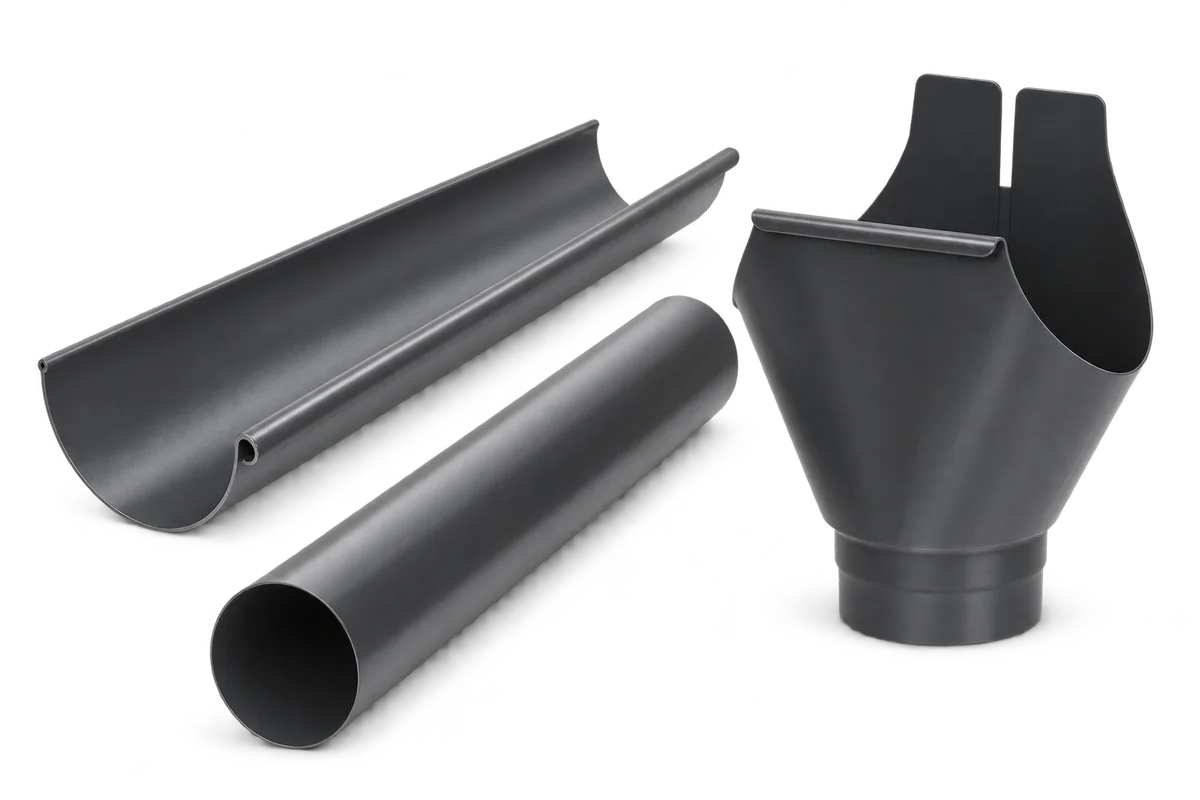
Half-round, box and concealed gutters differ in both geometry and detailing. One external dimension is not enough to compare capacity. With a concealed system, inspection access and protection against leaks are particularly important. A downpipe behind the façade needs careful detailing and a way to reach it for maintenance.
Match the gutter shape to the eaves detail and its junction with the roof covering. On a sandwich panel roof, check the bracket fixings and how the panel edge is closed. Do not assume a thin panel facing can carry any gutter load. Use both manufacturers’ instructions and the structural design to select the detail.
How should the system components work together?
Set the gutter to the specified fall, support it correctly and position it in relation to the roof slope. Take the dimensions from the documentation rather than relying on habit. The same applies to expansion gaps and jointing methods. Similar-looking parts can differ in shape, and mixing them can cause leaks.
In normal conditions, runoff should enter the gutter. Protect it from snow sliding off the roof; a gutter is not a snow guard. Include brackets, outlets, stop ends, bends and downpipe clips in the quote. A single missing fitting can hold up completion.
What should you check before buying?
Ask for a diagram showing each gutter run and outlet. Compare it with the roof drawing and site plan. Decide where the water will go after leaving the downpipe. Discharging it beside a wall can wet the ground around the foundations even if the gutter works perfectly.
After installation, check for leaks and test the flow. Keep the maintenance instructions and leave safe access for future inspections. You can match the colour to the windows, façade or roof once the technical requirements are settled. Well-planned gutters are part of both the roofing system and the way rainwater is managed around the building.