

Roofs and roof coverings
Trapezoidal or tile-profile roofing: which suits your building?
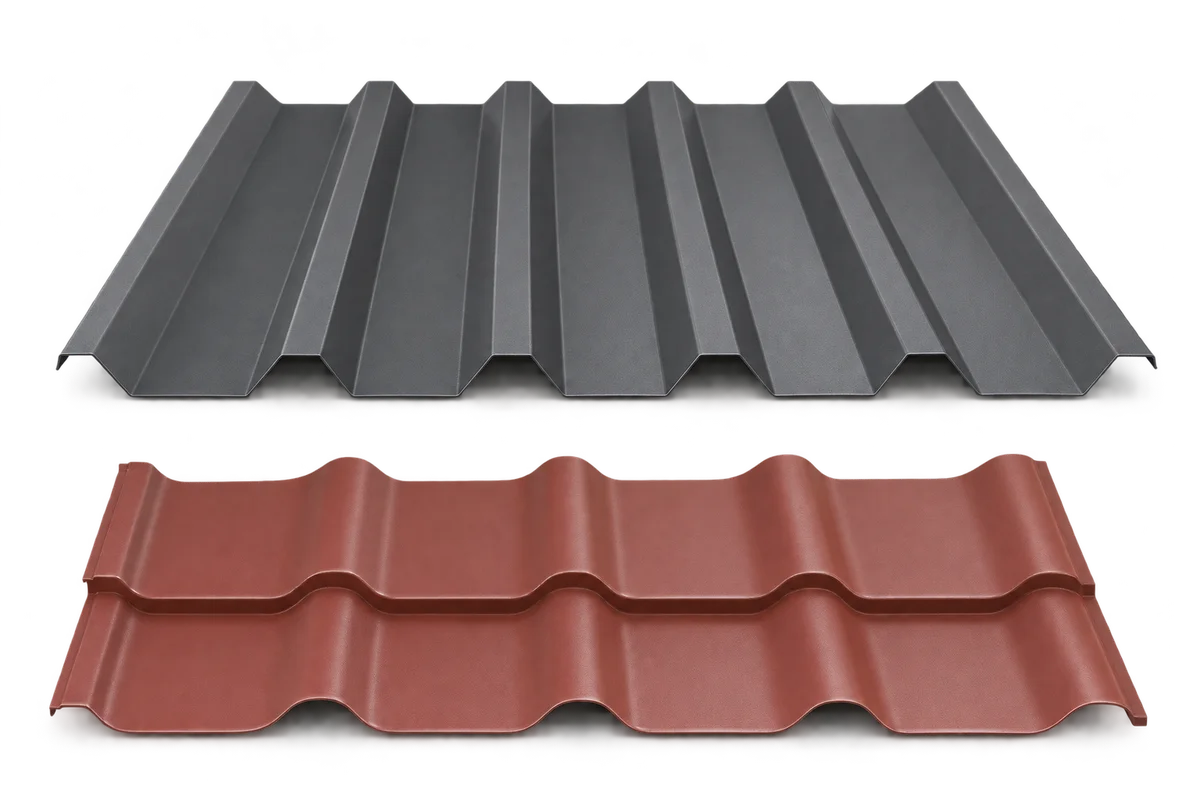
Trapezoidal steel sheets and tile-profile sheets are both lightweight roof coverings, but they differ in shape, support requirements and appearance. Start with the shape of the roof and, on a refurbishment, its condition. T18 and T35 can suit simple buildings; cut-to-length or modular tile-profile sheets give the roof a different pattern. Weigh the technical requirements, installed cost and appearance together. Check the pitch, the length of each slope, changes in direction and openings. Each model has its own limits, including a minimum pitch. These vary even within a product family: modular tile sheets do not all suit the same roofs, and not every trapezoidal sheet can be used on a near-flat roof.
In this guide
What limits your choice of roofing?
Before replacing the covering, assess the roof structure, supports and existing layers. A lighter sheet will not repair damaged timber or correct a structural defect. Check whether the existing battens suit the new profile: if their spacing is wrong, the sheets may lack support where they need to be fixed.
When does a T18 or T35 profile make sense?
Trapezoidal sheets form a simple surface with lengthwise ribs. They suit garages, carports and outbuildings, but can also complement a modern house. T18 gives a finer pattern; the ribs on T35 are more pronounced. Check the individual product sheet for its exact appearance and dimensions.
Load capacity depends on geometry, steel thickness and support spacing. The profile number alone does not tell you what loads the sheet can carry. Check snow and wind loads and the fixing pattern at the edges in particular. When ordering roof sheets, specify the coated face and the orientation of the overlap. A similar-looking wall sheet is not necessarily interchangeable.
What are the advantages of tile-profile sheets?
The transverse steps in tile-profile sheets echo rows of traditional tiles. They work well where this pattern suits the house. Profile height and shape affect how the whole roof looks. Hold a sample against the façade: a deep profile can look quite different on a small building than in a large catalogue rendering.
On a simple roof, tile-profile sheets cut to length can reduce the number of end laps. Smaller modules are easier to carry up and manoeuvre on roofs with many corners. Neither format always produces the least waste. A laying plan should show the installation direction and where offcuts can be reused.
Does the profile determine how warm or quiet the roof is?
A single steel sheet provides no thermal insulation. Comfort in a heated loft depends on the roof build-up as a whole and on its airtightness. Rain noise likewise travels through the covering, supporting structure and lining. Changing from trapezoidal to tile-profile sheets alone will not solve every noise problem.
Condensation can form on the underside of cold roofing. An anti-condensation fleece can hold moisture temporarily but must be able to dry. It does not replace ventilation or a specified membrane. If you need both an enclosure and insulation, compare insulated sandwich roof panels. They are a different system with their own requirements for supports and joints.
What should a price comparison include?
The price per square metre of sheet is not the cost per square metre of finished roof. Overlaps reduce cover, and cut-offs affect how much you need to order. Include flashings, screws, seals, delivery and fitting. On a refurbishment, add removal of the old covering, preparation and any repairs to the layers beneath.
Ask about steel thickness, coating and warranty cover. Two sheets in the same colour can have quite different specifications. Long sheets can be convenient, but need suitable lifting equipment or handling arrangements and room to unload. Include these costs when choosing a format. Check the underside coating as well as the conditions it is intended for: a dry loft and a humid building expose it to different conditions.
How do you decide, step by step?
First rule out options unsuitable for the pitch, loads or supporting structure. Then compare two clearly specified options of similar steel and coating quality. Ask for a cutting plan and a full list of accessories before judging appearance and price. This reduces the risk of choosing an attractive sheet that requires costly alterations. Remove the protective film within the period specified for the product.
Before ordering, agree how the sheets will be received, stored and worked on site. After installation, check the surface for damage or remaining swarf and inspect edges and penetrations. Both profiles can serve for years in a correctly designed roof. Choose the one that fits your project; there is no single best covering for every roof.