

PIR insulation
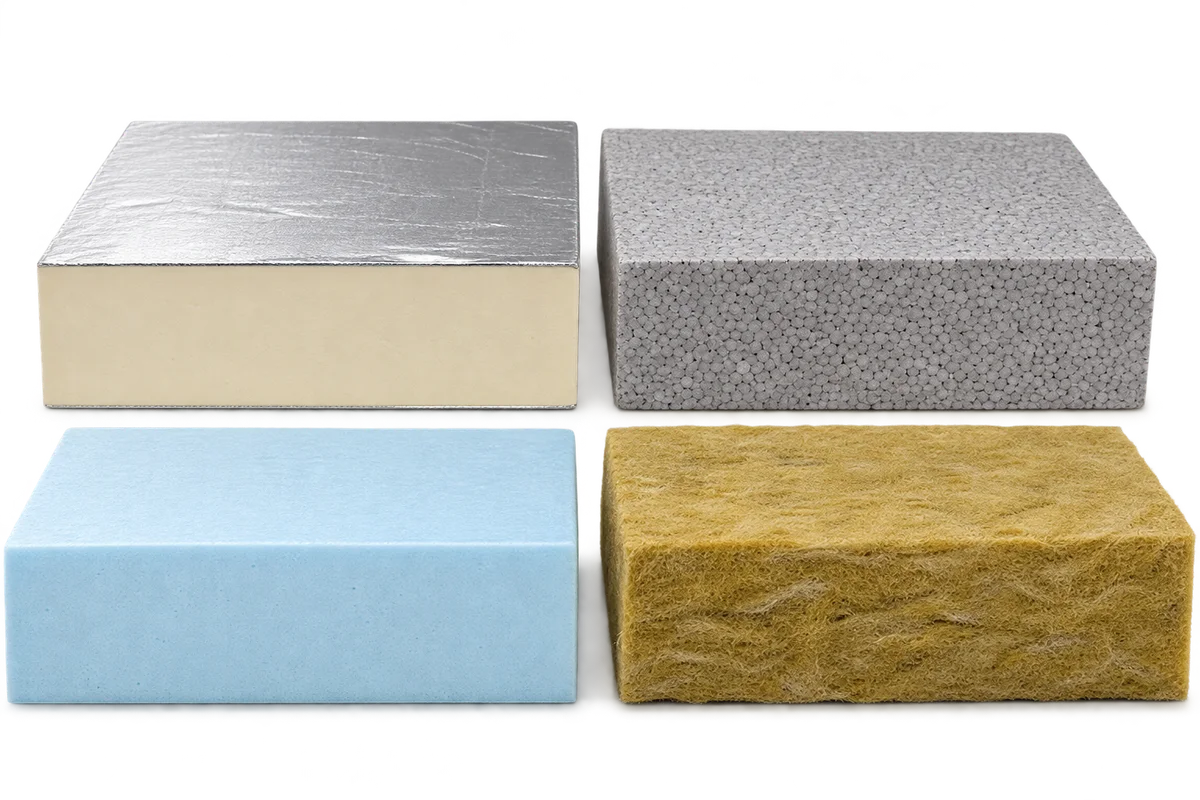
PIR, EPS, XPS or mineral wool: choosing insulation for your home
Insulation has a different job in each part of a house. PIR is useful where thickness is limited. EPS comes in grades for a wide range of uses. XPS suits applications where moisture and compressive loads matter. Mineral wool offers options for fire protection and acoustics. Start with the requirements for the building element, then compare conductivity and price. Thermal conductivity, or lambda, describes how readily heat passes through a material. A lower value means a thinner layer can provide the same thermal resistance. For a homogeneous layer, divide thickness in metres by conductivity to find its resistance. Two boards of equal thickness but different conductivity therefore deliver different results.
In this guide
Compare equal thermal resistance under the same conditions
Check the conditions for which the values were declared.
Thermal resistance is only one part of the assessment. Walls, floors and roofs must also carry their design loads and manage moisture. In some locations, acoustics or fire protection may govern the choice. Compare the price per square metre once you have identified suitable products and thicknesses. Allow for fixings, seals, protective layers and labour at junctions.
Where a thinner PIR board makes a difference
For example, a 10 cm PIR board with a conductivity of 0.022 W/(m·K) has a calculated thermal resistance of about 4.55 m²K/W. At 0.038 W/(m·K), a material needs about 17.3 cm for the same resistance. This difference can matter at a low threshold or when insulating a loft. Use the values for the specific products in question, as even PIR boards with different facings can have different thermal properties.
PIR boards are available for roofs and under screeds. Use a grade designed for the build-up. Rigid boards can form a continuous insulation layer when cut and joined accurately. They are combustible and need a separate waterproofing solution wherever one is required. A compressive stress declared at a large deformation cannot be used as the permissible permanent floor load. Check the long-term load separately.
Choosing the right grade of EPS
Façade EPS, floor insulation and resilient EPS for floating floors have different jobs. Specify them accordingly. Graphite EPS can have a lower conductivity than common white boards. At 0.031 W/(m·K), about 14.1 cm of EPS gives the same resistance as 10 cm of PIR at 0.022 W/(m·K). In this example, twice the PIR thickness would overstate the EPS requirement.
On a wall, make sure the board is compatible with the complete external insulation system. For floors, consider loads, screed thickness and deformation over time. Protect EPS from weather and overheating during storage and installation as specified. Choose a grade with the required properties and provide the specified protection against water, even when working to a tight budget.
XPS in contact with water and under sustained loads
XPS is often considered where low water absorption and resistance to compression matter. Examples include certain ground-contact applications, floors and inverted roofs. Each requires a suitable grade. Check the form of water exposure, board thickness and the conditions in the product documentation. Board colour or a description such as ‘hard insulation’ gives too little information.
The datasheet may give both compressive stress and compressive creep under sustained load. They describe different behaviour. XPS conductivity can also vary with thickness, so read the value for the board you will install. Compare its advantages over PIR or EPS for that particular application. Foundations and roofs can have very different requirements.
Assessing fire and acoustic performance separately for mineral wool
Some mineral wool products are non-combustible and achieve reaction-to-fire class A1. Fibrous insulation can also play an important part in sound control. Its effect depends on thickness and the construction around it. Sound insulation is influenced by the mass of the linings, the junctions and flanking transmission. Flexible batts for pitched roofs cannot simply be substituted for rigid roof boards.
Detail the build-up to protect mineral wool from unintended wetting and keep moisture conditions appropriate. Humid air alone does not inevitably cause irreversible damage to all mineral wool. Suitability depends on the product and surrounding layers. Mineral wool may need a greater thickness than PIR for the same thermal resistance, while meeting additional requirements elsewhere in the design.
Check the complete build-up before choosing a material
List the requirements for the location: target U-value, available depth, loads and water protection. Add fire and noise requirements, then compare product documentation. On a flat roof, check that the facing suits the waterproofing. For an external wall, verify the adhesive, fixings and finish as parts of one complete system.
PIR can be particularly useful when saving a few centimetres solves a difficult junction. Elsewhere, non-combustibility, resilience or behaviour in water may take priority. Different insulation materials can work well in one house if their junctions are continuous and correctly installed. Conductivity alone cannot determine that design.