

Roof details
How do you fit verge flashing and finish a gable edge?
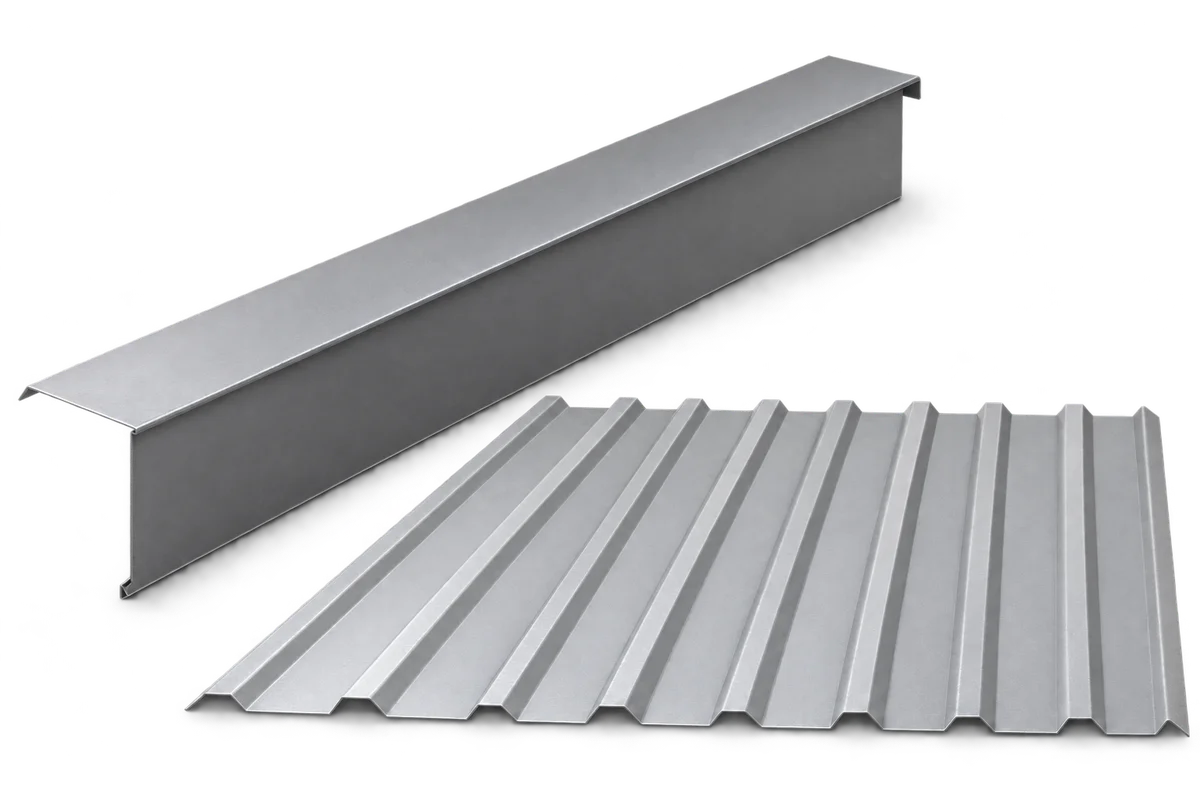
Verge flashing protects the gable edge of a roof and helps keep wind-driven rain from getting under the covering. Its effectiveness depends on the fixings, roof layers and drainage. A wide strip of metal alone cannot secure a roof against wind. Agree the section, laps and fasteners for the chosen covering before ordering custom flashings. At the gable, the roof covering, underlay and gable finish meet. The flashing protects this junction and directs runoff. Its shape depends on the profile height and how the covering terminates. Tile-effect steel sheets, T18 or T35 trapezoidal steel sheets and insulated roof panels may each require a different detail.
In this article
What does verge flashing do?
The complete fastening system resists wind loads. The flashing relies on the roof covering and structure being correctly anchored. Loads at roof edges can be particularly high. Use the design and the requirements for the specific product to determine fastener numbers.
Which measurements do you need to order the flashing?
Measure the height at the roof edge, the position of the bargeboard or other fixing base and the width to be covered. Check the profile actually installed. Show every fold and its direction on the drawing and identify the coated face. The fabricator can then bend the part with the correct side facing outwards.
Include the junctions with the eaves and ridge. The flashing should discharge water outwards at its ends. Allow for each lap when calculating the total order length. Simply adding the measured edge lengths can leave the final section short.
The flat blank needed to form a flashing differs in width from the finished section. The metalworker accounts for bending geometry and sheet thickness. Supply a legible sketch showing the dimensions of the finished section. Strip width alone leaves the leg heights and their orientation unspecified.
What should you prepare before installation?
The fixing base must be stable, level and consistent with the design. Check sheet edges and fixings. A flashing may not conceal a crooked line of sheets. Forcing it into place can create waviness or prevent the laps from closing properly.
Before closing the verge, check the underlay and the ventilation path. The flashing must discharge water clear of the underside of the membrane and keep required air paths open. On sandwich panels, protect the exposed core as specified for the system. The correct edge detail depends on the complete roof build-up.
How do you plan laps and fixings?
Arrange joints in the direction of water flow. The upslope length usually overlaps the one below, with the precise arrangement depending on the section. Follow the instructions for lap length and sealing. Extra sealant cannot compensate for a poorly shaped joint.
Choose fasteners for their fixing base and the load they carry. Timber, structural steel and thin metal facings need different fixings. Longer lengths also need room for thermal movement. Restraining them at arbitrary points can distort the metal as its temperature changes during the day.
How should coated sheet be cut and protected?
Use tools approved for coated sheet that avoid damaging heat at the cut edge. An angle grinder can damage the protective coating and scatter hot swarf over adjacent sheets. Cut at a prepared workstation and remove sharp metal offcuts before laying the next piece.
Treat scratches and cut edges that require protection as directed for the coating. An unsuitable touch-up paint may not adhere or match the colour. Lift flashings into position without dragging them across the finished roof. Planning the sequence limits cutting on the roof and the risk of scratches during lifting and fitting.
How do you inspect the finished verge?
Check the line of the verge, the position of each lap and the seating of fasteners. Water should have a clear route towards the eaves. Look for open joints, sharp edges or protrusions. Pay particular attention to the ridge junction and lower end, where several components must fit together.
After installation, clear away swarf and inspect the coating. Keep the fabrication drawing and material details. During subsequent inspections, also check the adjoining sheets, their fixings and the fixing base. A well-made verge flashing works together with the roof layers and fasteners as part of the complete gable detail.