

Sandwich panels
Building a large cold room with sandwich panels: from chamber design to an airtight enclosure
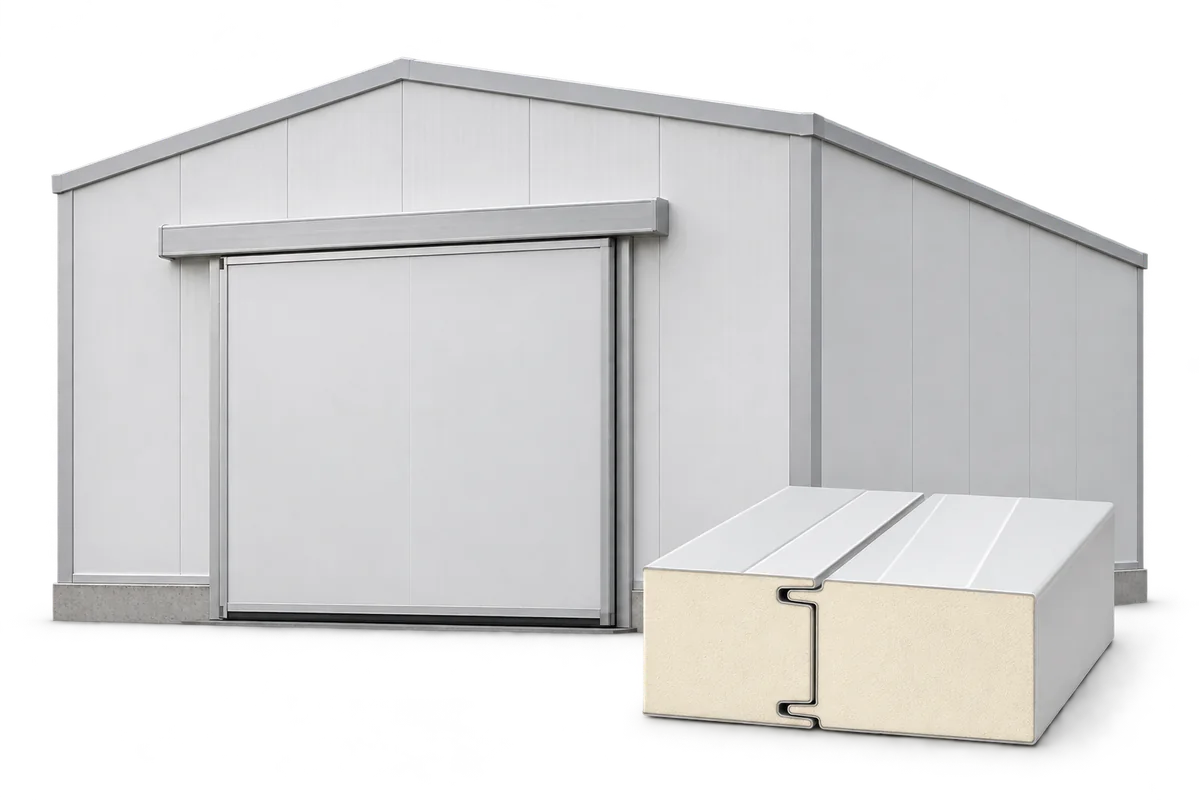
A cold room is a large insulated chamber, but its performance depends on the details. The walls, ceiling, floor and doors must limit heat and moisture ingress. PIR sandwich panels make it easier to build the envelope; they do not replace refrigeration equipment or a properly designed floor. In a freezer room, sealed joints and protection for components exposed to sustained low temperatures are particularly important. Chilled and frozen storage do not call for identical enclosures: operating temperatures differ, as do the consequences of moisture ingress. Before selecting panel thickness, tell the designer what goods will be stored, their temperature on arrival and how often the doors will open.
In this guide
Start with the temperature and how the room will be used
Floor area alone is not enough to size the system.
Distinguish between the sheltering building and the chamber inside it. The outer building can keep out the weather while the inner chamber maintains the required storage conditions. Each layer has its own function. A thin outer wall cannot be credited with the performance of the entire assembly or treated as a finished freezer enclosure.
How do you choose wall and ceiling panels?
A PIR core provides good thermal resistance at a moderate thickness. Demanding cold stores need panels with suitable joints and a documented scope of use. As well as the U-value, check panel lengths, supports and facings. The internal surface must meet hygiene requirements and withstand the cleaning agents in use.
Check the ceiling’s load capacity and suspension separately. A wall panel approved for use as a ceiling is not automatically a walkway. Maintenance access must follow the design. Pipework, unit coolers and other equipment need their own supports. Hanging them from the lower metal facing without a designed connection can damage the enclosure.
Why are joints just as important as panel thickness?
Warm, humid air leaking into a cold room increases the refrigeration load. Frost or ice may also form at leaks. The joints must therefore control air and vapour movement as specified. Simply engaging a tongue-and-groove joint does not necessarily complete the installation. The system documentation sets out where and how the joint must be sealed.
Pay particular attention to corners, ceiling and floor junctions, and door frames. Every service passing through a wall needs a durable seal. Do not leave these details for improvised repairs after start-up. Repairs in a cold chamber are harder, and ice can make it difficult to trace the point where air enters.
The floor must carry loads and limit heat flow
A cold-store floor carries racking and stock and takes traffic from lift trucks. Choose the insulation for the actual contact pressures and sustained loading. Compressive stress at ten per cent deformation is not enough on its own. Creep and load distribution through the floor layers also matter.
In a freezer room, assess the risk of the ground freezing and design appropriate protection. Both insulation thickness and the wall-to-floor junction matter. Depending on the conditions, suitable materials may include XPS or an appropriately specified PIR board. A thin product used in a wall cannot be assumed to be suitable under lift-truck wheel loads.
Treat the doors as part of the refrigeration design
Whenever the door opens, air at different temperatures and humidity levels comes into contact. In a busy cold store, traffic management can therefore have a noticeable effect on running costs. Plan the clear opening, door operation and measures to restrict unnecessary air exchange. Depending on the door system, freezer-room seals and thresholds may require protection against freezing.
Allow space for safe manoeuvring and protect the frame against impact. A damaged seal can increase refrigeration demand even in a well-insulated room. Include the doors in routine inspections. Replace worn parts before ice starts to prevent the door leaf from closing fully.
Check the chamber before the first delivery
After installation, remove metal swarf and construction waste, and strip off the protective film within the stated time. Inspect the facings, seals and flashings for damage or missing parts. Then commission the refrigeration system and observe the chamber in operation. Check temperatures at several points and inspect places where condensation or ice may form.
The documentation should specify cleaning conditions, maintenance procedures and service access. Agree how faults and changes to the services will be reported. A cable added later through a wall can compromise an airtight enclosure. A cold room is built to last when the structure, panels, doors and refrigeration equipment are treated as parts of one working system.