

Metal roofing
Trapezoidal steel sheet: applications, benefits and profile selection
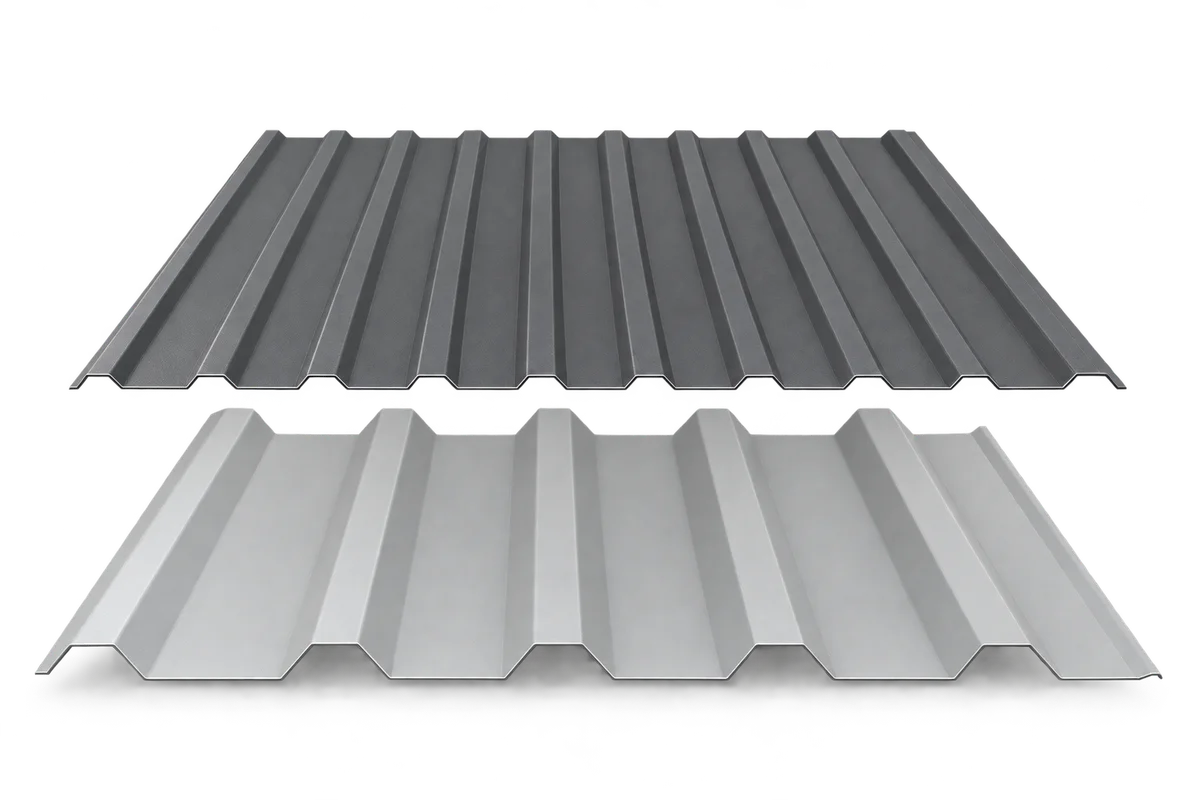
Trapezoidal steel sheet can clad a garage, form a house façade or serve as the structural roof deck of an industrial building. Each profile has its own job. T18 and T35 are common cladding profiles; structural decking must be selected by calculation. The sheets are light and quick to lay over large areas. Durability depends on the coating, detailing and conditions in service. Forming ribs in flat sheet stiffens the cross-section, so a relatively thin sheet can span between supports. Capacity depends on profile depth, flange widths, stiffening ribs and steel thickness. The T18 or T35 designation alone cannot replace the documentation for the particular sheet.
In this guide
What does the trapezoidal profile do?
Load direction and support layout also affect the choice. A wall sheet may have a different side lap or coated face from the roof version. State the intended use when ordering. Sheets that look alike are not necessarily interchangeable, particularly if their cover widths or drainage details differ.
Where are cladding profiles useful?
For a garage, carport or outbuilding, profiled sheet can quickly enclose a finished frame. T18 gives a fine, understated rhythm, while T35 produces a more pronounced pattern. On a house façade it can provide a contrast to render or timber. Look at a sample: profile depth changes how light and shadow fall.
A single sheet provides no thermal insulation. A heated building needs additional layers or a different enclosure, such as a suitable sandwich panel. Even an unheated building needs provision for condensation and ventilation. A low sheet price does not solve the problem of moisture beneath the metal.
When do you need structural decking?
On industrial roofs, deep profiles can provide the structural deck for insulation and waterproofing. Selection requires load tables and calculations for the actual support spacing. Steel grade, sheet thickness, orientation and number of spans all matter. A cladding sheet cannot replace this deck simply because both have a trapezoidal cross-section.
Allow for openings, equipment and installation loads. A heavy pack of materials placed without a plan can overload the deck locally. Structural decking needs suitable fixings to the frame and connections between sheets. Its low weight is an advantage, but does not mean the surface can carry any load placed on it.
How do you choose corrosion protection?
The metallic coating protects the steel; an organic coating can add protection and colour. Match the specification to the surroundings and to conditions on the underside. Farm buildings, damp warehouses and domestic carports expose sheets to different conditions. Neither a matt finish nor a warranty period in an advertisement tells you everything about durability.
Compare the full coating specifications and their conditions of use. Avoid contact with incompatible metals. Scratches, swarf and poor storage can damage the surface before the building is handed over. Even well-protected steel needs careful handling and periodic inspection of edges and joints.
What makes installation straightforward?
A good sheet layout reduces cutting and unnecessary laps. Plan transport and lifting so long sheets do not kink. Supports should be even and fixings suited to the substrate. Their number and position depend on loads, including higher wind loads in exposed zones of the envelope. Maintain the required roof pitch and detail the eaves, ridge and all penetrations correctly.
Cold-cut the sheet with a tool intended for the purpose. An angle grinder can damage the coating through heat and hot particles. Remove swarf afterwards and inspect the coating. Protective film is not meant to stay on a finished façade for long periods; follow the removal deadline for the particular product.
How do you compare the total cost?
Add flashings, fixings, transport and preparation of the structure to the sheet price. Compare the area actually covered after allowing for laps. For a heated building, include the insulation and other layers too. Only then can you fairly compare profiled sheets with metal roof tiles or sandwich panels.
Do not choose a profile on the lowest price per metre alone. The right sheet can simplify installation; the wrong one may need extra supports or rework. Trapezoidal steel sheet works well where a straightforward installation is backed by a clear specification. Start with the sheet’s role in the building, the loads it must carry and the details that keep the enclosure weathertight and durable.