

Construction and design
Choosing standing seam metal roofing: what should you check?
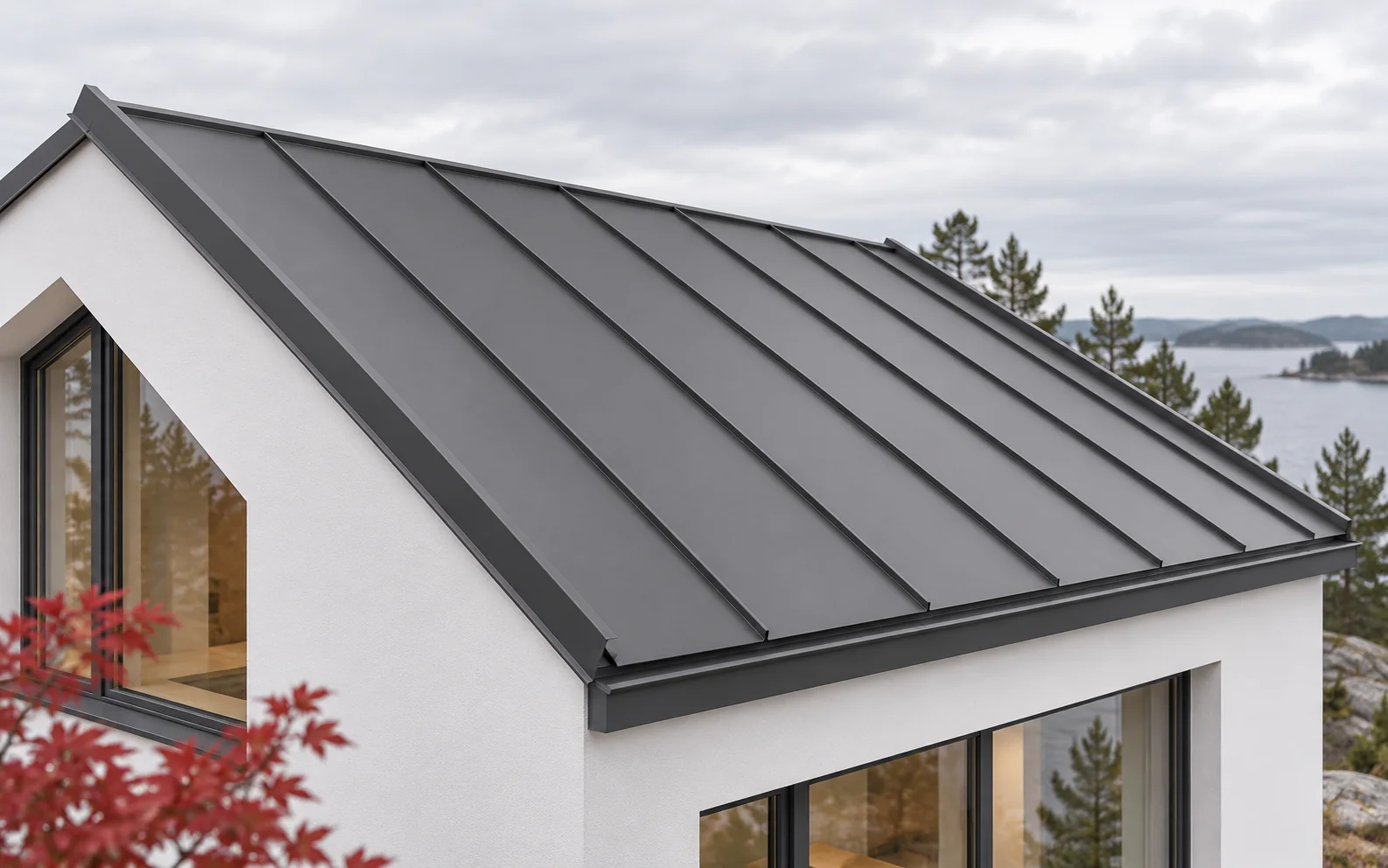
Standing seam panels give the roof a clean, longitudinal pattern, but they require a carefully prepared substrate and correctly executed details. A snap-lock system differs from a traditional standing seam that the roofer folds and closes by hand. Before choosing, you need to check the roof pitch, the panel lengths, the fixing method and the accepted appearance of the flat surface. A traditional standing seam is created by folding and closing the sheet metal edges in the appropriate way. In a snap-lock panel, the shape of the joint is formed at the factory. Installation consists of joining the matching edges in accordance with the instructions. These technologies may look similar from the ground, but they are not technically the same. They differ in substrate, fixing and the permitted detail solutions. The minimum pitch of a traditional double standing seam must not automatically be applied to any snap-lock panel.
In this article
Is every standing seam made the same way?
A traditional standing seam is formed by folding and closing the sheet edges appropriately. In a snap-lock panel, the profile of the joint is prepared at the factory. Installation consists of joining the matching edges in accordance with the instructions. These technologies may look similar from the ground, but they are not technically identical.
They differ in substrate, fixing and the permitted detail solutions. The minimum pitch of a traditional double standing seam must not automatically be transferred to any snap-lock panel. Ask precisely which system the offer covers. The word “standing seam” on its own is too general for selecting a roof.
Which building form suits longitudinal divisions?
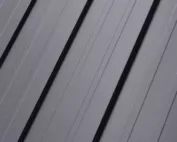
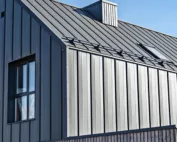
Standing seams lead the eye from the eaves to the ridge and emphasise the geometry of the roof slope. They combine well with a simple building form, but can also suit a traditional building. The effect depends on the panel width, the colour and the way the flashings are made. Too irregular a rhythm around windows can disturb the calm appearance.
Before ordering, draw out the divisions across the entire roof slope. Check the widths of the first and last field and the position of windows and chimneys. In a minimalist roof these relationships are very visible. It is not worth leaving them purely to chance resulting from laying sheets one after another from the edge.
Why can the surface undulate slightly?
Large flat areas of sheet metal can reveal slight unevenness and changes in light reflection. This is influenced by the properties of the material, the temperature and the support conditions. Not every visible undulation means a loss of tightness. However, not all creases caused by poor handling or installation can be regarded as natural.
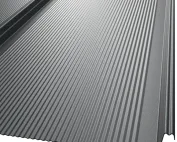
Aesthetic expectations are best established on a larger sample or a completed project. Slight profiling can reduce the visibility of undulation, but it does not guarantee a perfectly smooth surface in every light. If you expect an even mirror of sheet metal, you must check whether the chosen product meets such a requirement.
What is the significance of thermal movement?
Metal expands and contracts as the temperature changes. A long panel needs a method of fixing that allows for this movement. Blocking all points can cause stress and deformation. The design of the fixing holes, fixing zones and end details follows from the instructions for the given system.
Panels should not be extended beyond the range intended for the chosen variant. The colour and width of the flat field also matter for how the surface behaves. A length that is advantageous because it means fewer joints can at the same time make transport, lifting and checking thermal expansion more difficult.

What must be underneath the panel?
The substrate should meet the requirements of the specific covering. Depending on the system, a particular substructure, underlay and ventilation are specified. There is no single rule that every panel is laid the same way on full boarding or on arbitrarily spaced battens.
Unevenness in the substrate can be visible on flat sheet metal. The drainage of moisture from beneath the covering is also important. A membrane does not replace a ventilated cavity if the design requires one. In a heated attic, a complete insulation and vapour control system is needed, not merely a tight outer panel.
How does the standing seam compare with tile-effect metal roofing?
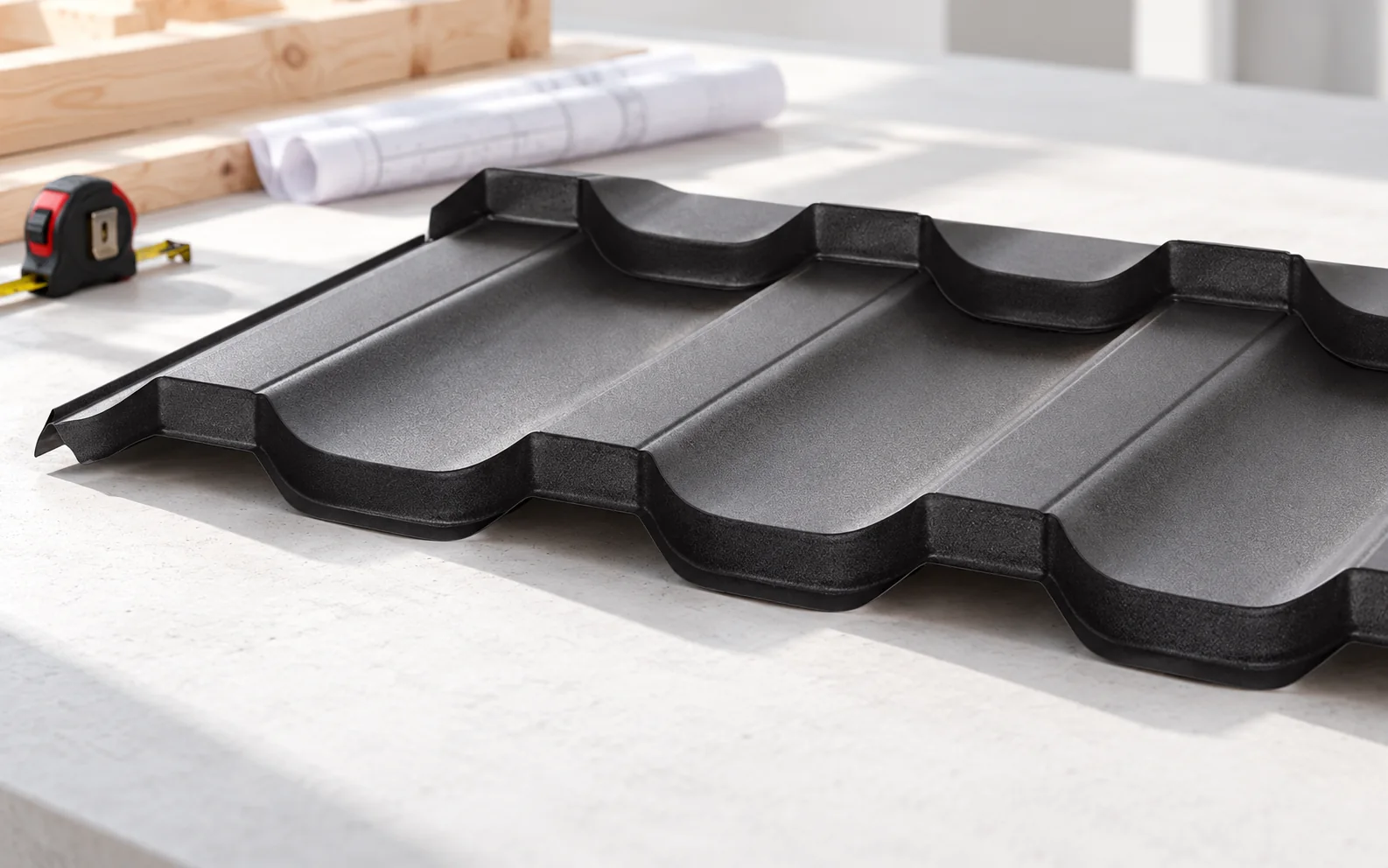
Tile-effect metal roofing creates a transverse rhythm of rows, while a standing seam emphasises long lines. Cut tile-effect metal roofing can be convenient on simple roof slopes, while the modular version makes it easier to work with smaller elements. A standing seam panel has its own installation requirements. None of these technologies should be chosen on fashion alone.
A price comparison must include the substrate, flashings, fixings and labour. Differences in the execution around a chimney or window can affect the cost more than the rate per square metre of sheet metal itself. It is best to prepare offers for the same roof, with similar coating protection and a clearly defined scope of work.
What decides a successful choice?
Check the instructions, the warranty conditions and the contractor’s experience with the given system. Ask about the eaves detail, the ridge and the longitudinal joints. The way service penetrations are made and how future equipment is fixed are important. Not every clamp or bracket is suitable for every type of standing seam.
At handover, assess the roof under agreed conditions, not only in extreme side light. At the same time, pay attention to actual creases, damage to the coating and accidentally blocked fixings. Keep the profile data and the documentation. This will make inspections and any later work on the covering easier.
Tip before ordering
Before deciding, look at a real roof with the chosen type of panel in sunshine and under cloud. Also ask whether it is a snap-lock standing seam or a traditionally closed one. A similar photograph does not guarantee the same technology.
What is worth remembering?
Standing seam panels are a good choice when they suit the building form and the technical conditions of the roof. The characteristics of flat sheet metal must be accepted, and a correct substrate and thermal movement must be ensured. Price and appearance should be assessed for the complete system.
7 branches. Materials closer to your project.

Free quote
Materials for your project

You may also find useful…
Rafter sizes are determined by structural calculations, in which span, spacing, type of support, timber class and loads govern the cross-section; the…
The price per metre is a convenient reference point, but it does not describe the whole order. Cold-formed profiles of the same…
If you suspect that work on a building in Poland was unauthorised, compare what stands on the site with the approved documents.…
A steel roof with integrated photovoltaics can be an interesting alternative to heavier coverings combined with a separate installation. Its mass must…
Start a solar assessment with four separate figures: system generation, on-site use, electricity imported from the grid and electricity exported. The number…
Handing over the roof to the next crew requires identifying the completed scope, the reservations that remain and the conditions for safely…
Before altering a PIR panel roof, identify the exact product and the assembly in which it was tested. Check three separate properties:…
Base cooperation with the construction manager on clear inspection points, documents and decision routes. In Poland, statutory responsibilities include directing construction, maintaining…