

Sheet-metal flashings
Estimating roof valley flashing costs, including sheet metal offcuts
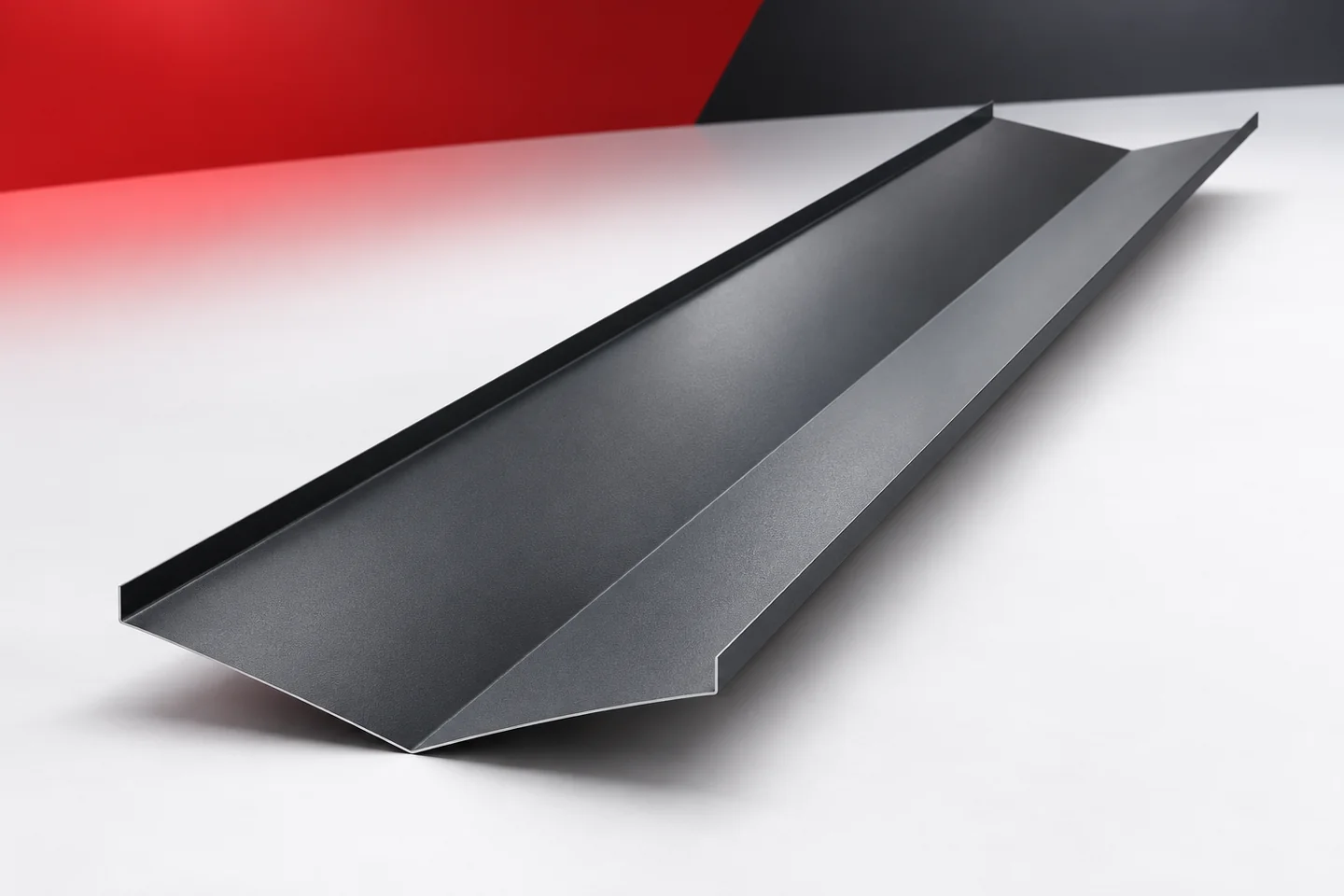
The roof valley collects water from the converging roof slopes. Its flashing must match the roof geometry and ensure an unobstructed drainage path. When buying, what counts is not only the length of the valley gutter but also its developed width, its joints and the cuts to the covering. These are the figures that let you assess the cost without a false saving on too narrow a profile. Water from both sides of the roof meets in the depression between the slopes. This is therefore not an ordinary finish to a side edge. The valley gutter has to take this flow and direct it towards the eaves. Its cross-section is chosen with regard to the layout of the slopes, not solely on the available width of the sheet-metal strip.
In this article
The valley is a point of greater water inflow
What matters is the length of the valley, the pitch and the area of roof from which water reaches it. The ends at a dormer or another obstruction are also important. If these conditions are unusual, bespoke flashing may be needed. Merely widening the visible gap between the coverings will not replace checking the whole detail.
The developed width shows material consumption
The developed width is the width of the sheet-metal strip needed to form the cross-section before bending, determined with regard to the processing technology. Two valley gutters of the same length can have different developed widths. They then have a different material cost and may perform a different function in the detail. They are not equivalent merely because both are called a valley.
In the enquiry, state the widths of the central part, the side parts and the bends. For a system profile, an unambiguous indication of the correct cross-section is sufficient. Avoid the description “standard valley” if the offer contains several variants. A drawing allows the supplier to calculate the material and the installer to check the fit with the planned cutting line of the covering.
Covering waste is a separate item
At a valley, the roof sheets meet at an angle and require cutting. The resulting pieces cannot always be used elsewhere on the roof. The direction of the profile, the arrangement of the seams or the spacing of the ribs can be an obstacle. The area of the roof slope therefore need not correspond to the area of the sheets ordered.
It is worth calculating the cost of the valley gutter and the cost of the covering waste separately. This shows what results from the roof geometry and what from the choice of material. Reducing the flashing in order to conceal badly calculated cuts is not a saving. The covering must end in such a way that it does not block the flow and allows the edges to be formed correctly.
Arrange joints in line with the direction of flow
Valley gutters are often made from several sections. The joint should lead the water downwards, not open a gap beneath its inflow. The length of the overlap and the sealing depend on the chosen solution. There is no single figure that can be applied to every covering and pitch without checking.
In the quotation, allow for the length consumed by joints and for the final fitting. Pay attention to the method of fixing. Piercing the base of the valley in the path of the water flow can be a serious error. The choice of brackets or other fasteners follows from the documentation. The solution should also take account of the thermal movement of the flashing.


Match the valley material to the water load
Galvanised, aluzinc and coated sheet metals are used for valley gutters. The choice requires compatibility with the covering and with the operating conditions. It is not enough to assume that an invisible section may have any protection. Leaves and deposits can remain in the valley and hinder the surface from drying out.
Coated coloured sheet metal makes it easier to match the visible strip to the roof. Durability, however, is determined by the full specification and correct execution. When choosing, also check the recommendations for treating cut edges. Do not treat touch-up paint as a way of repairing deep deformation or a badly formed profile.
Check the valley end at the eaves
The water must leave the valley in the intended way. The lower end should work together with the eaves flashing strips and the drainage system. A concentrated stream occurs at this point, so an accidental overlap can change its direction. A drawing of the end is particularly useful with a complex eaves.
Ridge tiles, barge boards and starter profiles belong to other zones, but all should be included in the complete set of flashings. If a chimney is located near the valley, its aprons can affect the flow. The chimney flashings must then be considered together with the surrounding roof slope, and not as an isolated fragment of the order.
Accept the profile and plan access for inspection
Before installation, check the straightness of the base and the condition of the side bends. The valley gutter should not have dents forming local pools. After the work is completed, filings and waste are removed. The edges of the cut sheets should also be inspected so that they do not obscure too large a part of the drainage path.
In later use, the free flow of the valley needs to be checked. Leaves or branches can negate the advantages of a correct cross-section. When pricing unusual sheet-metal flashings, it is therefore worth also assessing the possibility of cleaning. A well-designed detail can be inspected and maintained, and its cost can be clearly broken down into material and execution.
Questions and answers
Will a narrower valley reduce the cost without changing performance?
This cannot be assumed. The width and cross-section follow from the drainage conditions and the covering. Any change must be checked technically before ordering.
Can every cut-off piece of covering be used?
No. The direction of the profile, the position of the seam and the dimensions all matter. Waste at the valley must be allowed for in the cutting plan for the whole roof.
7 branches. Materials closer to your project.

Free quote
Materials for your project
You may also find useful…
Concrete tiles and tile-effect steel place different loads on the same roof and call for different delivery arrangements. Compare their weight per…
The cost of an industrial building includes the work needed to run the business inside it. Alongside the frame and cladding, allow…
Flat-roof insulation selection starts with the position of the waterproofing. In a conventional warm roof it protects the insulation from above; in…
The price of a picket is easy to compare. It is harder to compare two quotes when one covers only the slats…
The same PIR thickness appears in two quotes, but one board has an aluminium facing and the other a mineral fleece. The…
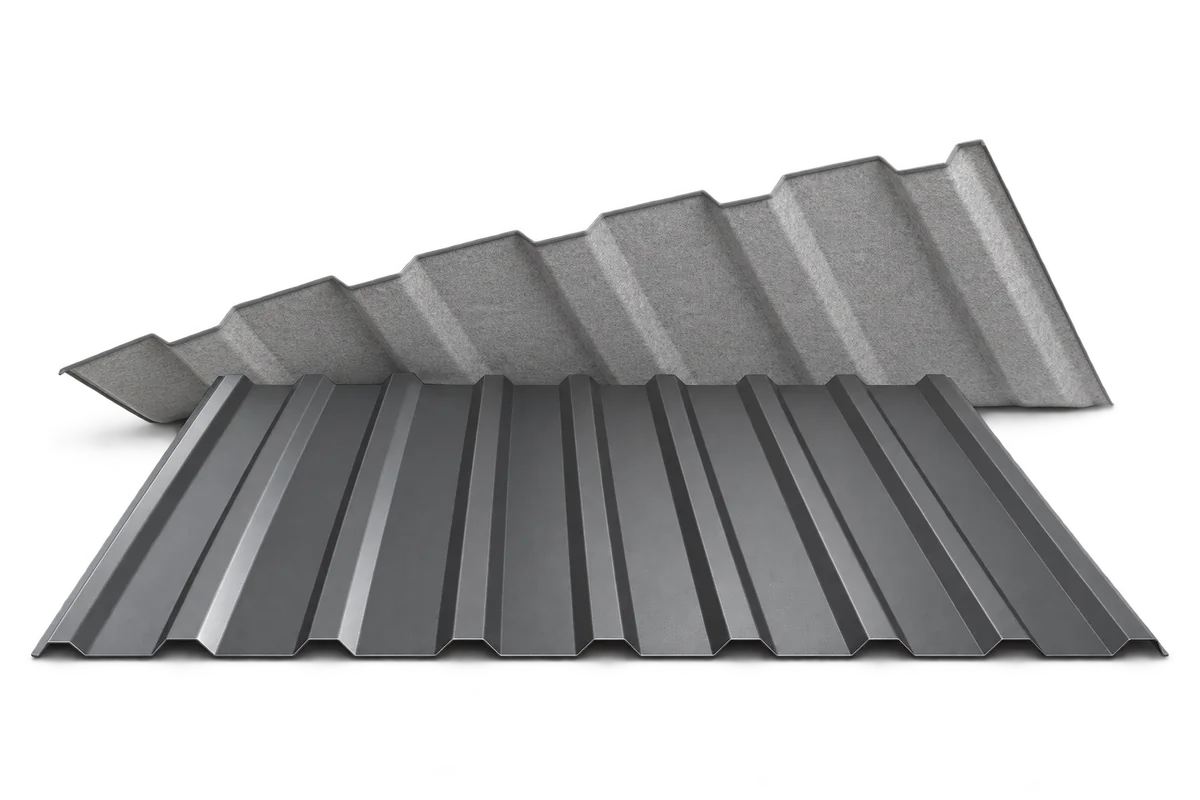
A claim that a material makes a roof quieter becomes useful only when it explains which sound is reduced and which construction…
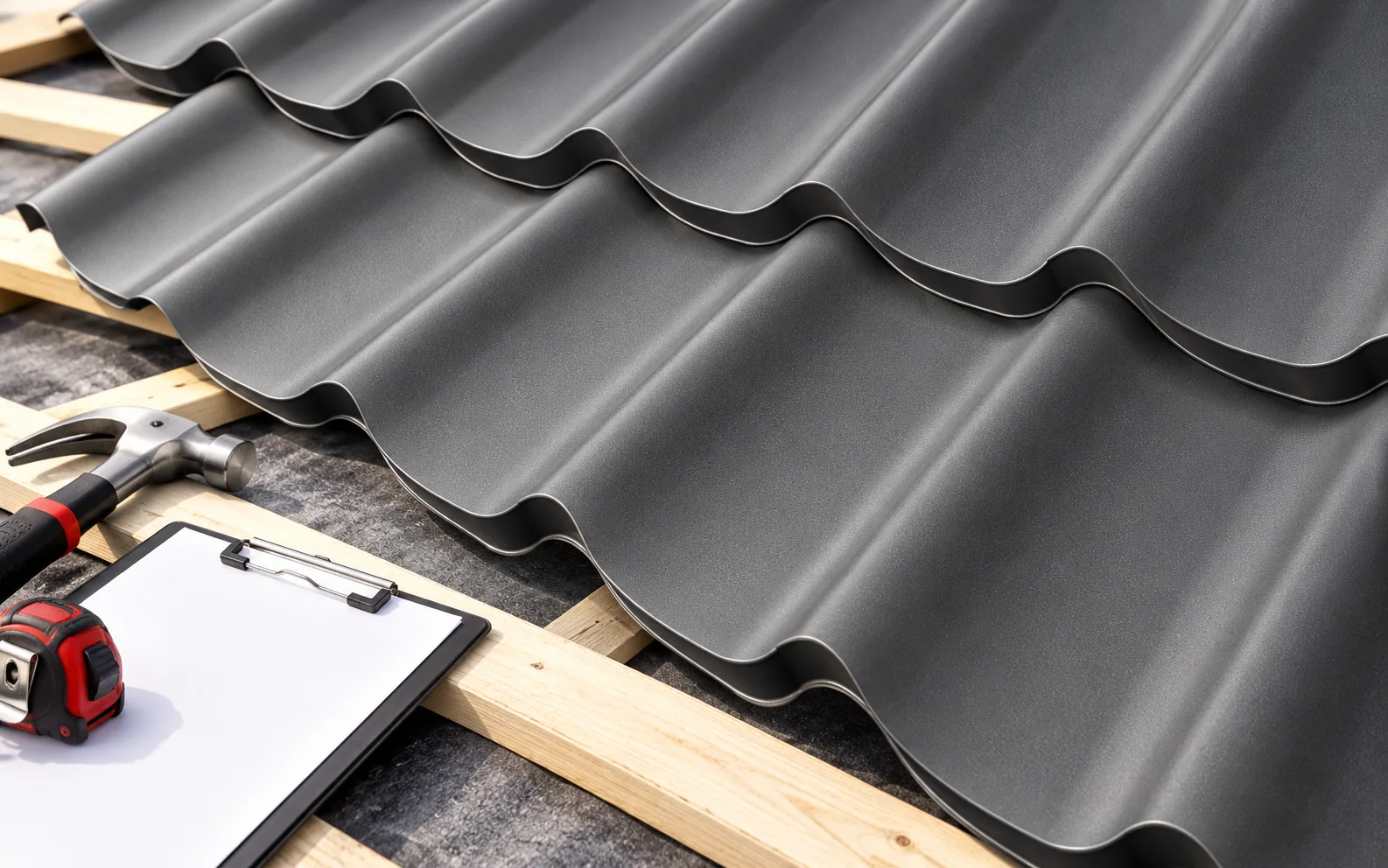
To estimate the labour cost of laying metal sheeting on a roof, start from a complete bill of quantities, not from the…
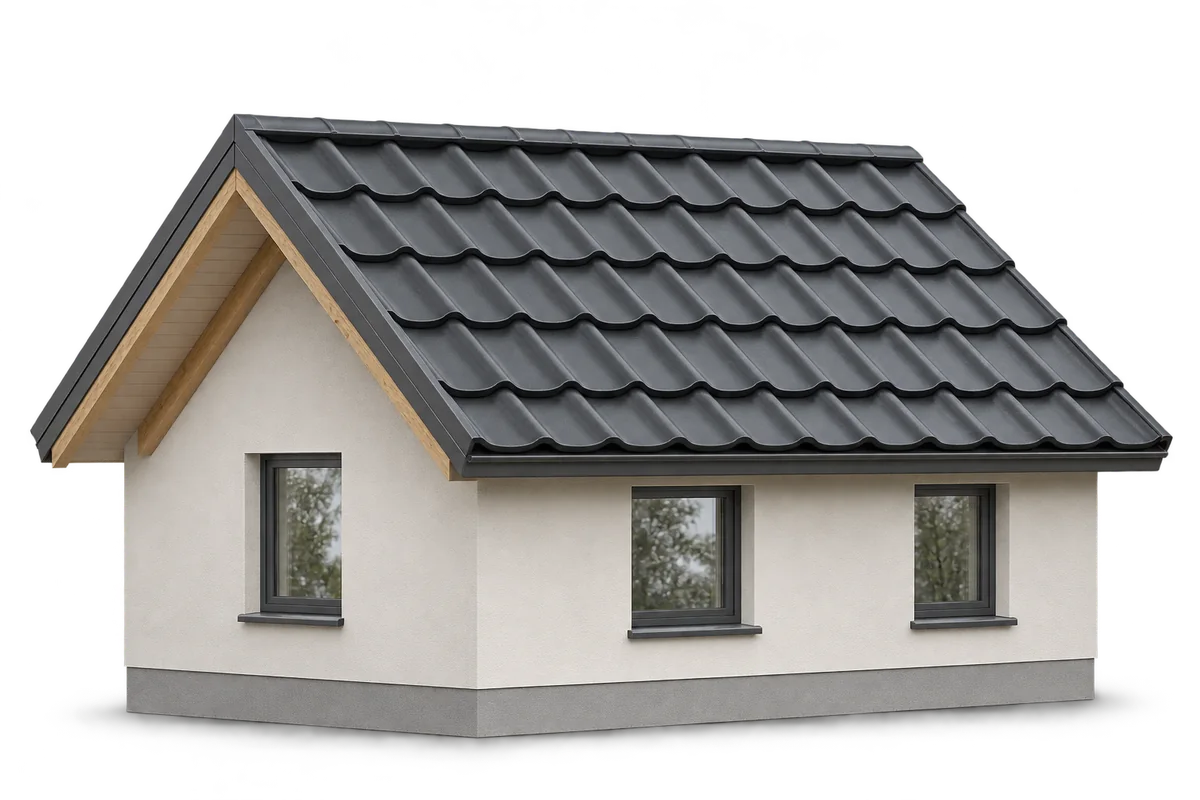
A gable roof joins two slopes at a ridge, but its simple outline does not establish the structure or insulation arrangement. Before…