

PIR insulation
Utherm Roof BM: when the facing matters more than a single lambda value
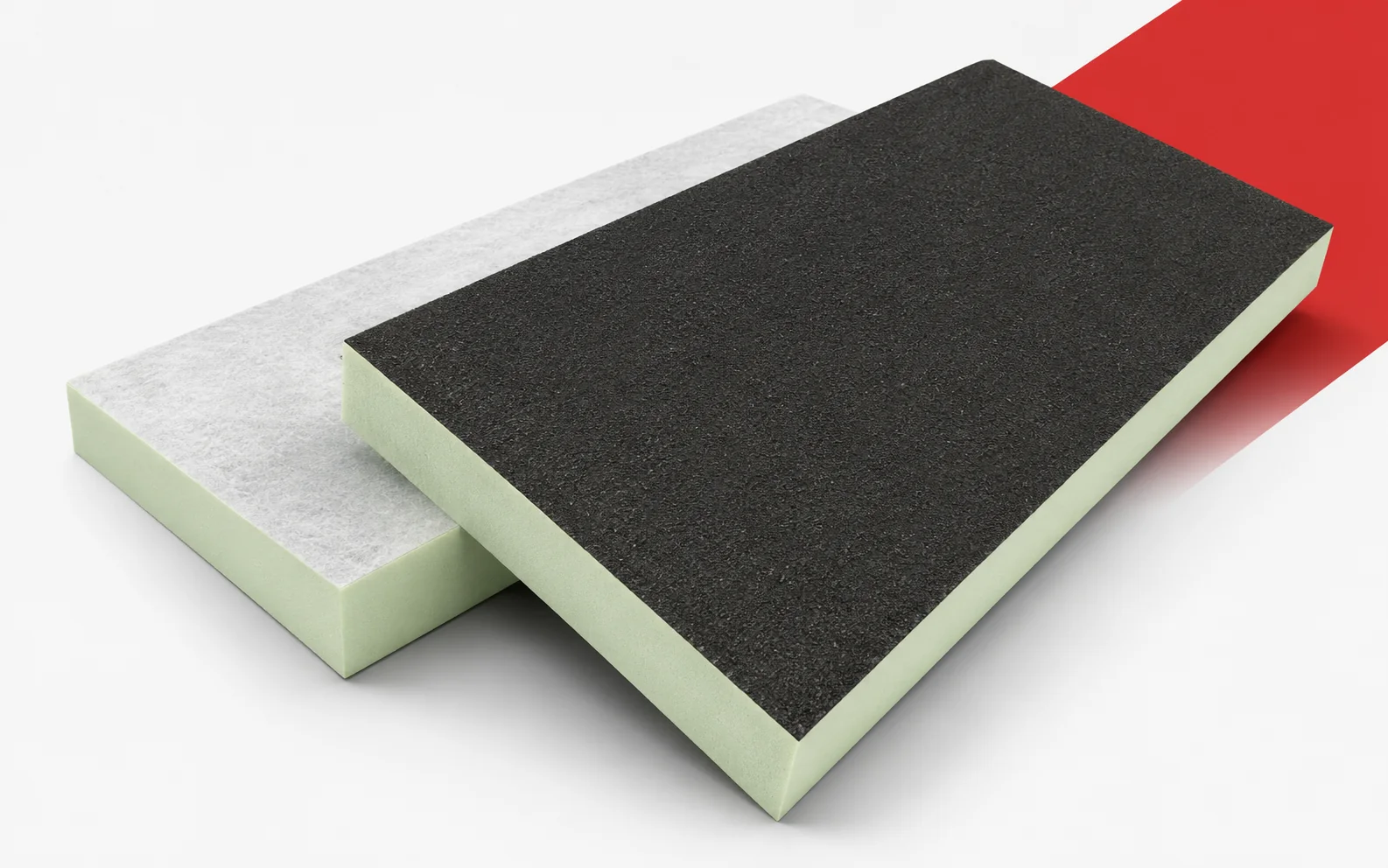
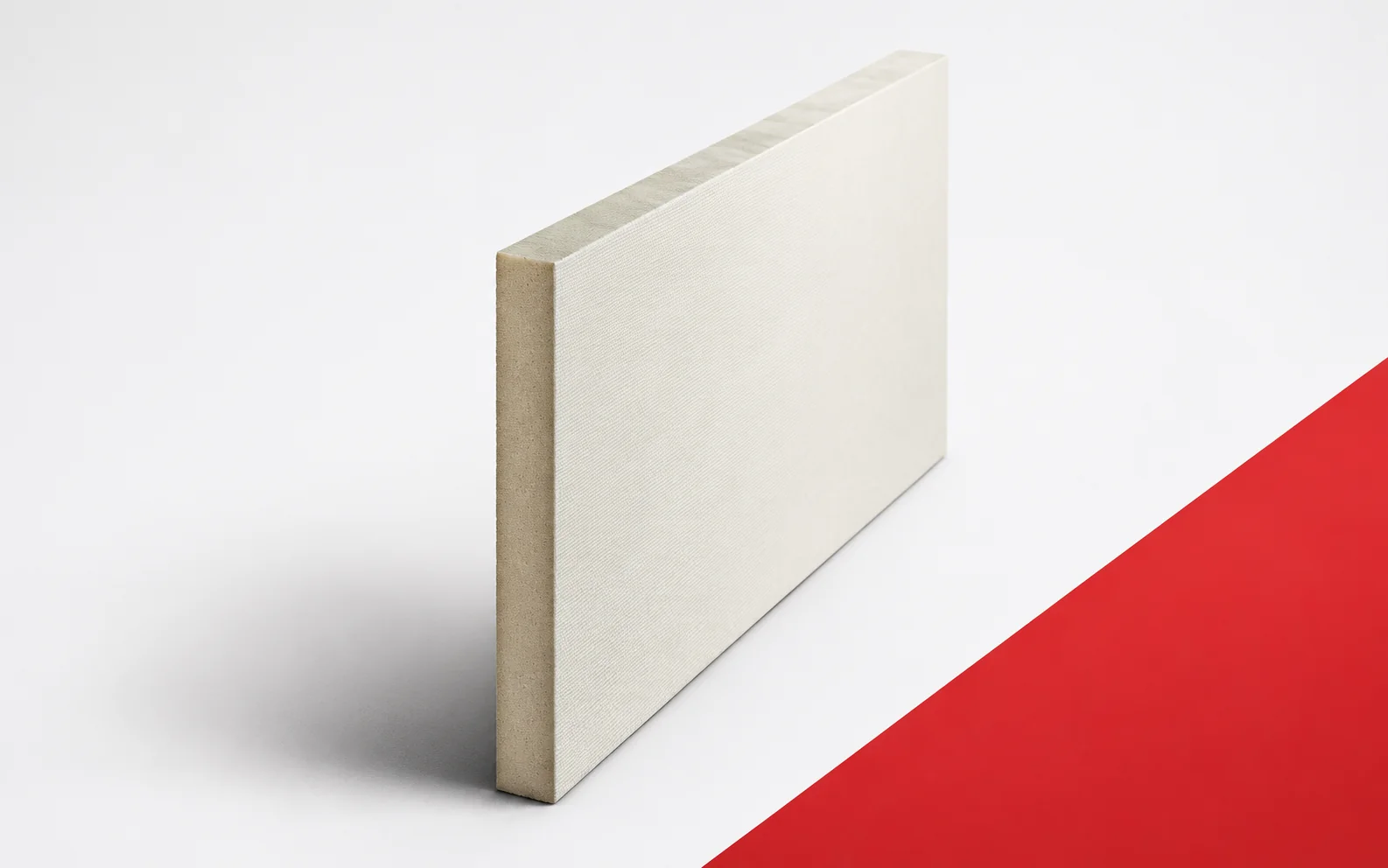
Utherm Roof BM shows why a single lambda value should not be applied to every PIR thickness. The two different board surfaces also matter. For an energy assessment, the parameters of the specific variant must be read together with the requirements of the intended covering. Utherm Roof BM is a PIR board with different facings on its two sides. One surface is finished with a bituminised glass fleece. The terms “polyurethane boards” and “polyurethane foam” are broader than the precise PIR product designation. When assessing the space available for PIR boards, the two different surfaces of Utherm Roof BM must be checked: the bituminised and the mineralised. To assess the spatial benefit, the orientation of the bituminised and mineralised side of Roof BM must be established.
In this article
PIR Roof BM boards with two different facings
Full selection requires more than reading the lambda, because the gas-permeable fleece must not be equated with an aluminium laminate. The selection should help assign the correct contact with the adjacent layer to each side of the board. Before comparing variants, show the description of the facings and the technology for making the connection to the covering on a single drawing.
Roof BM lambda dependent on thickness
The thermal conductivity value in the Roof BM technical data sheet depends on thickness. For thicknesses from 30 to 70 mm it is 0,027 W/(m·K), at 80 and 100 mm it is 0,026, and for 120–150 mm it is 0,024. An energy comparison should therefore account for the change from 0,026 W/(m·K) at 100 mm to 0,024 W/(m·K) at 120 mm.
The thermal calculation will be clear only if the parameters of each Roof BM thickness variant under consideration can be read separately. The difference in thickness requires correct interpretation, since the quotient d/λ must not use the lambda of another thickness range of this board. The calculation should allow thermal variants to be compared without transferring the best result to the whole family. As a basis for the decision, retain the declared R_D of 3.80 for 100 mm and 5.00 m²K/W for 120 mm, instead of comparing only the price per centimetre of material.
Polyurethane insulation with straight edges
The board format is 1200 × 600 mm and its edges are straight. Before laying, the surface orientation must be confirmed and the requirements of the waterproofing system checked. The continuity of the polyurethane insulation must also be maintained where the arrangement of the straight edges of Roof BM boards in the 1200 × 600 mm format needs to be resolved.
When analysing continuity, it is worth planning offset joints and Roof BM cuts at roof elements. The fit must be assessed for the actual geometry, because a straight edge has no factory overlap that could be matched in the adjacent row. The installation plan should allow continuous contact between boards and correct termination of the layer at the edges. In the energy assessment, include the distribution of joints, the support of edge elements and the method of forming penetrations, because these places will remain after purchasing the board with the best lambda.
Contact with the covering and sequence of work
At the junction of insulation and covering, adhesion, cleanliness and dryness of the surface are what matter. Fixing must be checked for the central, edge and corner zones of the roof. To preserve the thermal improvement, the method of joining the covering to the bituminised surface of Roof BM must be verified.
When assessing the durability of the effect, the documentation for the first layer of covering above Roof BM should be checked. The actual construction of the connection is important, because the presence of bitumen in the facing does not constitute consent for arbitrary torch work. The layer build-up should allow compatible contact materials and the sequence of work to be selected for the actual roof. At acceptance before covering, it is worth comparing the type of adhesive or fixing and the surface preparation conditions with the adopted detail.
CS150 and class F within the correct scope
Roof BM has a declared compressive stress of at least 150 kPa at 10% deformation and a fire reaction class of F. These two pieces of information describe different properties. When limiting layer height, the CS stress of at least 150 kPa and the fire reaction F declared for Roof BM must be assessed in parallel.
Beyond selecting the lambda, the Roof BM test result must also be separated from the requirements of the complete roof covering. It is worth separating these requirements, because the compression value and the reaction class describe different phenomena and do not prove arbitrary load-bearing capacity. The collected data should allow loads and fire protection to be assessed within the appropriate scope. Alongside the thermal calculation, present the product data together with the support, fixing and system classification solution, so that the result relates to a usable solution.
Polyurethane insulation: selection and quote for Roof BM
The enquiry must specify Roof BM with its full designation, the thickness and the selected waterproofing. The note “PIR board” alone is not precise enough. When comparing cost and effect, include the Roof BM offer covering the correct bonding side and thickness variant.
Before calculating cost-effectiveness, it is worth linking the supply of Roof BM with the materials needed for a compatible covering. The cost-effectiveness calculation will be incomplete if it is omitted that the same PIR name does not mean interchangeable facings or an identical lambda. The selected variant should allow complete solutions to be compared once the required insulation level has been established. When assessing the surcharge, set the full board designation, a description of the contact layers and the scope of work at details against the benefit obtained in the finished building element.
A case worth considering
A comparison of Roof BM 100 and 120 mm shows the importance of reading the correct range. The catalogue R_D is 3.80 and 5.00 m²K/W respectively. Both the thickness and the lambda change. Both variants should therefore not be calculated with one arbitrarily chosen value. In the energy assessment, the compatibility of the facing with the planned covering must be retained in parallel.
7 branches. Materials closer to your project.

Free quote
Materials for your project

You may also find useful…
Less space for insulation does not have to mean giving up good thermal resistance. PIR boards help to solve this problem if…
The bill of materials for an energy-efficient house should link every delivery item to the building envelope component and detail shown in…
The cost of insulating a home includes materials, substrate preparation, installation and finishing of details. The price per square metre of the…
Insulating an agricultural building begins with identifying the function of each room, not with choosing a panel thickness. A vegetable store, a…
swissporPIR Alu can help achieve the required thermal resistance within a limited construction thickness. The benefit is particularly evident where every centimetre…
For MG, a change of thickness from 100 to 120 mm is being considered. This also means moving into a different lambda…
Thermano ETICS combines the low thermal conductivity of PIR with an outer layer of EPS. This solution is intended to help in…
Select roof insulation for the layer arrangement, available height and loads. PIR often achieves the required thermal resistance at a smaller thickness.…