

Mineral wool sandwich panels
Where can you use a 60 mm mineral wool panel, and how do you check a 40 mm offer?
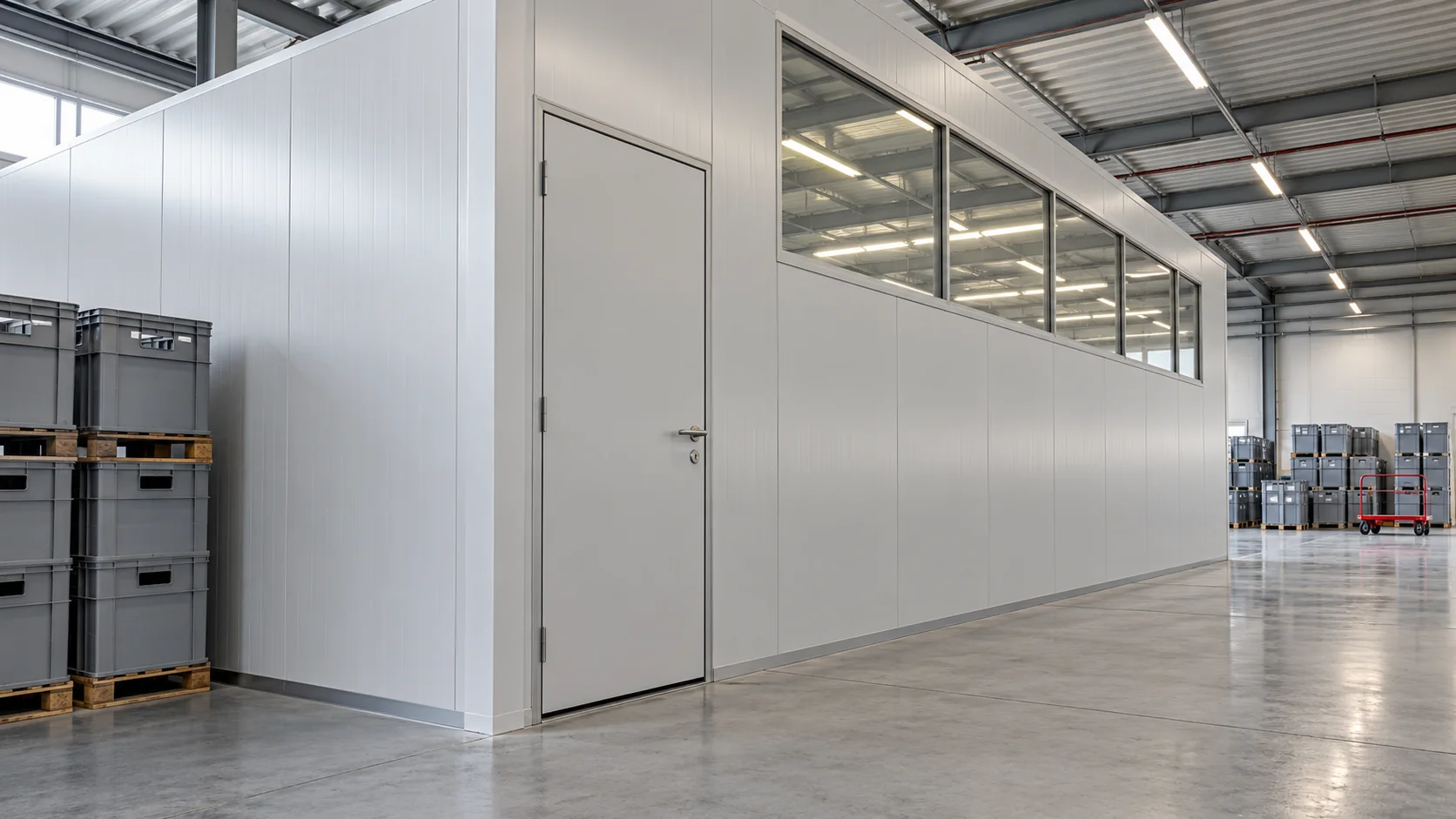
Some wall panel ranges include a 60 mm mineral wool option. Its suitability depends on the job the wall has to do. Enclosing a dry storage area inside a hall or an unheated room places different thermal demands on a panel from cladding a heated office. A 60 mm panel may suit the former uses if it meets the project’s other requirements, including fixing and fire protection. For a 40 mm offer, first identify the exact product and obtain its documentation. The same nominal thickness can refer to a different core or a different type of construction.
In this article
Define the purpose of a thin partition
Establish the temperature difference across the wall, the humidity and the wall’s function. An internal partition may need a particular fire resistance rating even if thermal insulation is of little importance. Its location indoors is only one part of the specification.
What 60 mm means for heat transfer
One example of a 60 mm mineral wool wall panel has a stated Uc of 0.66 W/(m²·K). This figure applies to that variant and illustrates the limits of thin cladding for heated buildings. Check it against the design requirement for the complete wall before considering it as an alternative to a much thicker panel.
For intermittently used rooms, consider the heating and ventilation pattern. Warm air can improve comfort quickly while junctions remain cold enough for condensation at high humidity. Assess these conditions along with the space saved by a thin panel.
Identify the product behind a 40 mm offer
Some manufacturers’ ranges of mineral wool wall panels start at 60 mm. Other systems may have a different range. For a 40 mm offer, ask for the data sheet and declaration of performance for that exact product.
Check the technical designation, core, intended use, facings and how the thickness is measured. An insulation board for on-site build-up, a panel with a different core and a self-supporting sandwich panel are distinct products. A photograph of a white facing and the description “40 mm panel” cannot distinguish them.
Check the declaration for the exact thickness
A panel range may cover several thicknesses with different declared properties. Read the 60 mm column or the separate entry for the size on offer. Check the footnotes and any entries indicating that no performance has been declared. Leave a blank entry unresolved until the supplier confirms the required property for the version you intend to order. A figure from an adjacent column applies to that other variant.

Establish the fire rating from the documentation
The non-combustibility of mineral wool alone does not establish the fire resistance of a thin wall. An entry marked NPD means “no performance determined” for that characteristic. A rating from a thicker panel in the same range cannot fill the gap.
If the partition must achieve an EI rating, select a wall assembly within the scope of the relevant classification. Include the junctions with the floor, the slab above and adjoining walls. Ease of installation does not reduce the fire protection requirements.
Assess stiffness and impact exposure
Allowable span depends on the complete panel construction and the loads. Check the permitted height and select supports, fixings and framing around openings. Allow for the weight of doors and the loads caused by frequent opening.
In a small store, a trolley, crate or corner of a rack may strike the wall. Consider an independent impact barrier at low level. Thin panels can work well where the operating layout and protection keep impacts off the cladding.
Compare the cost of the complete partition
A thinner panel may save weight and space but require a different support layout. Extra rails, flashings or reinforcement can change the total price. Compare complete partitions of the same size and function, including doors and installation.
Allow for a change of use. If a dry store is later converted to a heated workstation, the original partition may need rebuilding. Record the limits of the chosen system so the owner can assess future changes to equipment or operating temperature.
Questions and answers
Is 60 mm enough for the wall of a heated workshop?
Check the wall requirements, the data for the specific panel and the building’s operating conditions. Thin panels provide limited thermal insulation, and thickness alone cannot establish suitability.
What if a supplier offers a 40 mm mineral wool panel without a data sheet?
Ask for the exact product designation and documents confirming its intended use and declared performance. Data for another thickness or core cannot verify the offer.
7 branches. Materials closer to your project.

Free quote
Materials for your project
You may also find useful…

Start with the panel price per square metre, then work out the cost of the finished wall. Thickness, facings, coating, panel lengths…
Weight per square metre helps compare panels, but the site team needs the weight of the whole unit. This depends on length,…
A fibreglass lining on the underside of a farm building roof can make the interior easier to clean if the material suits…
Start with what the wall or roof has to do before comparing panel prices and thicknesses. PIR is a rigid foam with…
A mineral wool sandwich panel can help a wall meet its fire and thermal requirements. In everyday use, the panel’s weight, the…
Each fastener transfers loads from the panel to the supporting structure and must seal the hole through the facing. Select it for…
The answer to the question of insulating a loft before installing the lining comes down to the correct sequence of work and…
Thermal conductivity, or lambda, describes how a material conducts heat. The U-value describes heat transfer through a particular product or building element.…