

Installation and details
How to organise safe access to and movement on a roof?
Safe access to the roof and movement on it require planned access, fall protection and verification of the load-bearing capacity of the support points. In many cases, a preliminary assessment from the ground, from the loft or by means of photographs is sufficient, which allows the risk to be reduced. If direct access is necessary, the scope of work must be established in advance, and the task should be entrusted to persons prepared for work at height. The article explains why the covering is not an ordinary walking surface, how to plan access and descent, what role fall protection plays, what roof steps and roof walkways are for, and when access must be abandoned. It also emphasises the importance of documentation and of preparing the roof for later servicing.
In this article
Is access to the roof slope really necessary?
Start with the purpose of the inspection. Some defects can be preliminarily identified from the ground, from the loft or by means of photographs taken with suitable equipment. Such an assessment does not replace every inspection, but it can reduce unnecessary risk. It is not worth going onto the roof just to take a single photograph of a leak.
If direct access is needed, the scope of work should be established in advance. Inspecting a chimney requires different preparation from repairing at the eaves. It is worth assigning the task to a team with the right equipment. Improvisation that begins on the ladder makes it difficult to assess hazards and to return safely.
Why is the covering not an ordinary walking surface?
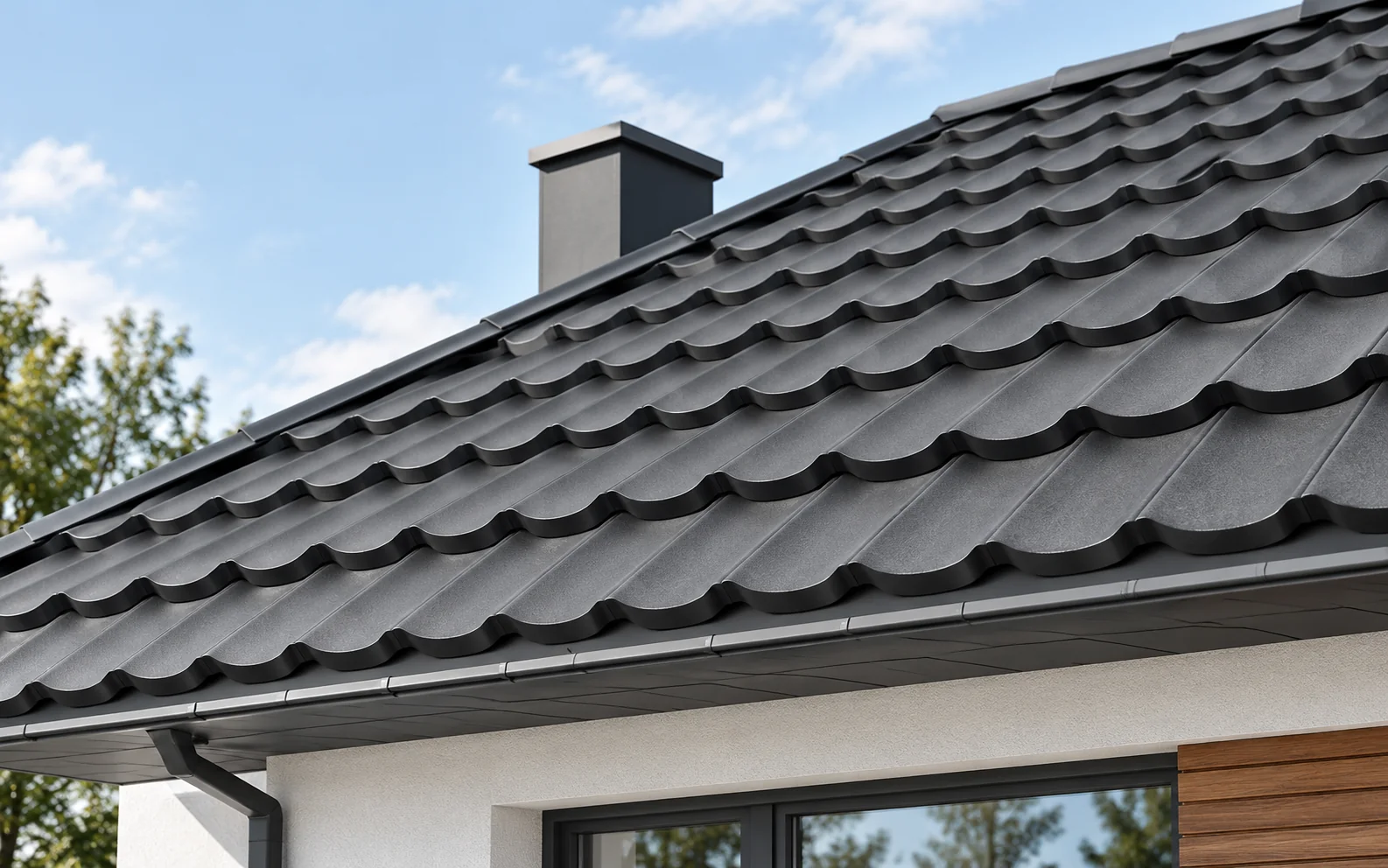
The metal sheet can carry design distributed loads, but this does not mean unlimited resistance to foot pressure. Profile, thickness and support location matter. T18, T35 and tile-effect metal roofing behave differently. Access rules derive from the documentation and assessment of the specific roof.
Skylights, penetrations and weakened sections are particularly dangerous. A layer of dirt can make it difficult to recognise the boundaries of elements. It must not be assumed that every part of the roof slope has the same load-bearing capacity. This also applies to old coverings whose condition and method of fixing have not been checked.
How to plan access and descent?
Access should lead to a place from which work can begin safely. Depending on the task, suitable scaffolding, platforms, equipment or permanent access solutions are used. A ladder requires correct positioning and securing. It is not automatically a suitable position for prolonged work at the eaves.
The transition from the access equipment onto the roof and the return route must be taken into account. These are places where stable support is easily lost. Hands should not be occupied with loose tools during movement. The method of transporting materials and equipment must be prepared separately, before ascending to height.
What role does fall protection play?
First, the possibility of using collective protection such as properly prepared railings or platforms is assessed. When a personal protection system is needed, it must be selected for the task. Buying a harness alone does not create complete protection. The connection, the anchor point and the space required for it to function also matter.
The protection must not be attached to a random gutter, flashing or chimney. The anchor point must be intended and verified for such a function. The system should take into account how a person is rescued after an incident. Working alone without a prepared emergency procedure increases the risk of serious consequences of a fall.

What are roof steps and roof walkways for?
The access elements form the intended route to the chimney or to equipment requiring servicing. They must be matched to the covering and fixed to the correct structure. Their arrangement should allow use in accordance with their purpose. It is not enough to screw a random step to the thin surface of the sheet.
A roof walkway is not automatically an anchor point for fall protection. This function is determined by the documentation of the specific product and its installation. The condition of the fixings and corrosion must also be checked periodically. An element left unchecked for many years should not be regarded as reliable merely because it still looks solid.
When must access be abandoned?
Rain, icing and strong wind can prevent safe work. Wet leaves, dust and other contaminants on the metal sheeting also increase the risk. Work should be carried out in conditions suitable for the method used. Time pressure does not justify ignoring the limitations arising from the weather and the condition of the surface.
Unknown load-bearing capacity, lack of edge protection or damaged equipment are also reasons to stop. The strength of a suspect section must not be tested with one’s own body weight. A doubt requires assessment and a change of organisation. A safe plan allows for the possibility of postponing the task, not only for a way to complete it quickly.
How to prepare the roof for later servicing?
Already during construction, it is worth planning access to chimneys, antennas, drains and installations. Points requiring frequent inspection should have a designated servicing route. Additional equipment must not block the access route. This also applies to photovoltaics installed after the roofing work is completed.
Keep the documentation of the access system and any anchor points. Record the inspection rules and the permitted method of use. The information should be available to subsequent teams. The owner can prepare the servicing conditions, but should not himself replace a person with appropriate preparation for work at height.
Tip before ordering
Before ordering an inspection, provide the team with photographs of the roof, the eaves height and a description of the available access points. Ask how access, protection and any emergency assistance will be organised. This is more important than a promise to carry out the work without additional equipment.
What is worth remembering?
Safe movement on the roof requires proper organisation and functional protection. Footwear, caution and dry weather do not replace this preparation. The best solution is to limit unnecessary access and to provide planned access for the persons carrying out servicing.
7 branches. Materials closer to your project.

Free quote
Materials for your project




You may also find useful…
A granular-coated tile-effect metal roof has a steel core and an outer layer of fine mineral aggregate held by a suitable binder.…
Preparing an investment covers the plot, the design, the correct procedure and the documents needed to start work. The scope depends on…
A company's roof should match the way the building is used while creating a coherent appearance with the walls. An insulated roof…
On a flat roof, swissporPIR Alu can reduce the height of the regular thermal insulation layer. However, the reserve must also be…
Shade on a roof is not a fixed patch. It moves with the sun and changes in length over the course of…
Roof maintenance should not begin with a breakdown. Fibre cement sheets need checks on the joints, the drainage and the places where…
To estimate the labour cost of laying metal sheeting on a roof, start from a complete bill of quantities, not from the…
Preparing a roof for winter covers three areas: drainage, the safety of components and moisture control beneath the covering. The response to…