

PIR insulation
Powerdeck F on flat roofs: thermal performance and compatibility with roof waterproofing
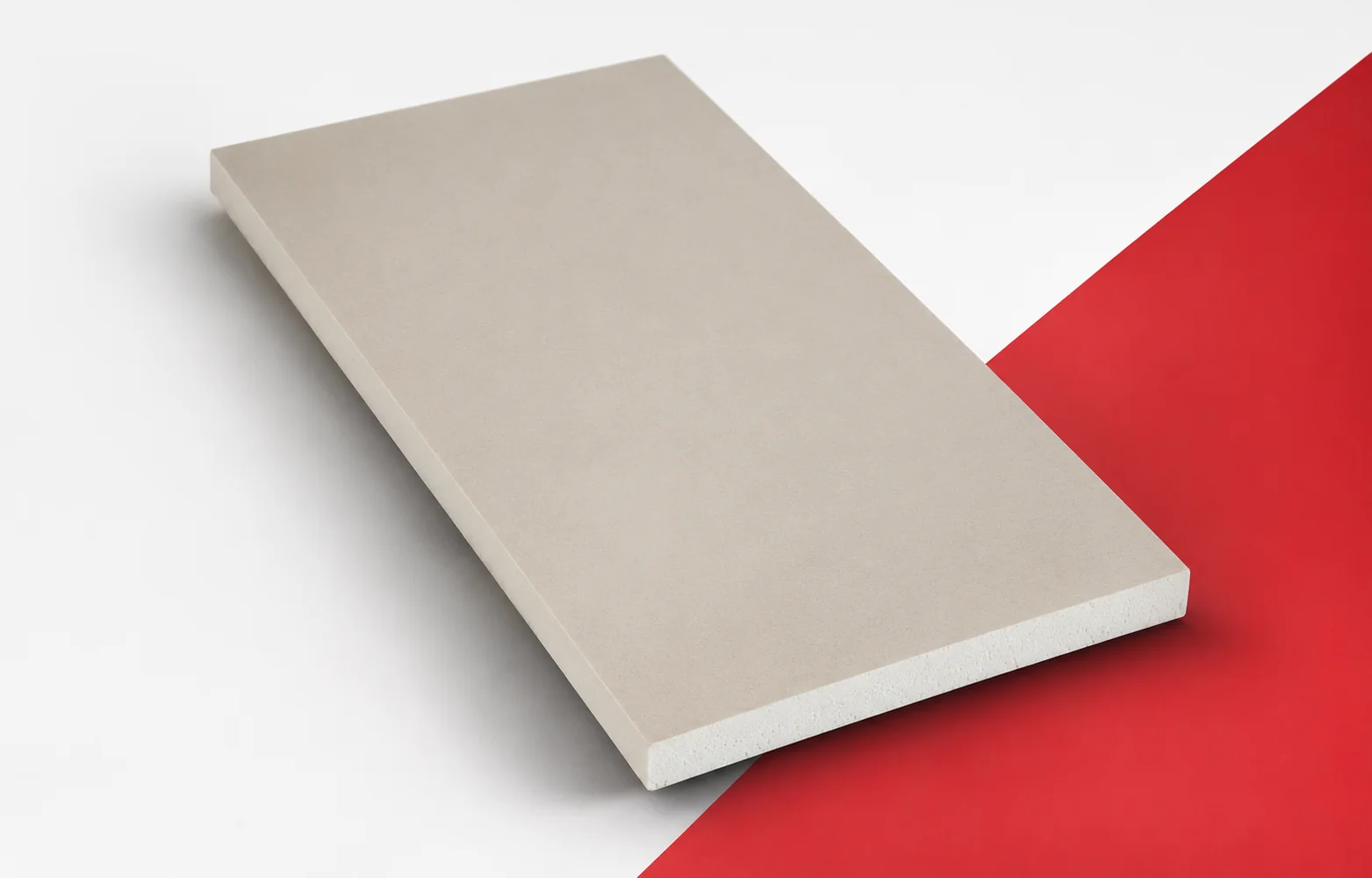
Thermal insulation is not the only property that matters beneath a roof covering. Powerdeck F has a facing that is matched to the relevant system. The energy benefit should therefore go hand in hand with a durable bond between the insulation, the substrate and the waterproofing. Recticel Powerdeck F has a PIR core coated on both sides with a mineralised glass fleece. The product is intended for flat roofs with a suitably selected covering. PIR boards are best assessed in relation to a specific spatial problem, so regard the mineralised glass fleece of Powerdeck F as a surface that works together with the covering. The Powerdeck F facing must be matched to the materials adjoining it in the chosen roof assembly, because the space saving must be assessed together with the geometry of the detail.
In this article
Board construction and the role of the insulation
A change in lambda alone is not enough, because a similar colour of the PIR core does not determine whether the surface is compatible with the chosen membrane. The solution should allow the choice of product to be based on the requirements of the specific roof assembly. As a starting point for comparing variants, record the type of facing, the adopted covering and the documentation of their mutual compatibility.
How to compare the thermal effect
For Powerdeck F boards, the declared thermal conductivity lambda is 0.026 W/(m·K). It is on this value that the comparison of the thermal resistance of a layer of a given thickness must be based.
When comparing polyurethane boards, include the calculation of the Powerdeck F layer with the declared lambda of 0.026 W/(m·K). The thickness of Powerdeck F must be calculated with its own lambda of 0.026 W/(m·K), so that the comparison relates to the same thermal effect. The result must be read with caution, since quoting a lambda of 0.022 from another product would lead to an incorrect result for this board. The calculation is intended to help determine the thickness resulting from the parameters of Powerdeck F rather than from the general name PIR. In the energy summary, show the design resistance, the available layer height and the calculation of the full roof section, so that it is clear what exactly changed between the solutions.
At a given roof height, Powerdeck F must be calculated with its own lambda of 0.026. For an example of 100 mm, a simple d/λ gives approximately 3.85 m²K/W. This is not a result that can be improved by attributing to the board a parameter from another PIR variant. The advantage of the chosen product may lie in the suitability of its facing for a specific covering system. The comparison should therefore set the required thermal effect against the actual method of constructing the roof.
Where the advantage can be lost
The Powerdeck F product data sheet specifies straight edges and a tongued-and-grooved variant. Whether a given format and thickness are available must be confirmed for the specific variant being ordered.
Check the straight-edge or tongued-and-grooved variant specified for the Powerdeck F version being ordered, because continuous polyurethane insulation also requires correct terminations. The side geometry of Powerdeck F must be agreed before determining the cutting plan and the number of boards ordered, because losses at the joints must be assessed together with the main insulation field. A good joint does not arise automatically, since a change of format or side profile affects offcuts and the actual surface coverage. The layout of elements should allow the delivery geometry to be agreed before the number of boards and the direction of successive rows are fixed. On the detail drawing, show the format as ordered, the method of bringing the elements together and the support at the end of the field; this record will make it easier to check the work later.
Durability of the assembly and moisture conditions
Powerdeck F can be combined with selected glued or self-adhesive membranes and with suitable fastening systems. The mere name of the adhesive – polyurethane or bituminous – does not by itself determine compatibility.
When assessing the durability of the thermal effect, include the bond with a bonded or self-adhesive membrane in a clearly defined material set. When bonding, the compatibility of the membrane and the bonding material with the mineralised glass fleece must be confirmed if the insulation is to perform under the conditions assumed in the design. Polyurethane foam does not replace protective layers: the general chemical name of the adhesive does not replace confirmation of the compatibility of the specific product. The intended safeguards should allow the bonding method to be selected together with surface preparation and installation conditions. Before covering up, assess the system instructions, the requirements for the substrate and the method of checking the bond before the details are covered, because later repair may require opening up the finished assembly.
The remaining requirements do not disappear
For Powerdeck F, the declared compressive strength is CS(10/Y)120. Fire reaction class E is given for thicknesses from 40 mm, whereas B-s2,d0 relates to the specific end use.
The thickness limitation does not release you from checking other requirements, so analyse the CS120 declaration and the conditions of class E stated for Powerdeck F from 40 mm. The end-use classification must be linked to the actual substrate and fixing of Powerdeck F, even when the choice of board was mainly determined by its low lambda. A separate assessment is needed because a change of covering or fixing may go beyond the scope of the previously assessed assembly. Only a complete set of data will allow the requirements of the whole roof to be maintained when considering mechanics and behaviour in fire. Alongside the thermal results, state the board thickness, the complete layers and the documentation corresponding to the actual method of fixing them; this will ensure that the comparison does not omit the service conditions.
When the solution is worthwhile
When purchasing Powerdeck F, both the board thickness and the joint detailing must be agreed. The quotation should cover substrate preparation, the required layers and the details.
Polyurethane board insulation should have a calculated effect and a defined scope of works; include the cost of substrate preparation and of connecting the insulation to the chosen waterproofing system. The quote should include substrate preparation and all materials needed to install the covering, so that the cost relates to a single, comparable result. The price of the material is only part of the decision, since a favourable board price does not automatically include priming, bonding and the making of flashings. The final summary should allow the expenditure leading to a finished, watertight covering with specified requirements to be compared. Ask for a schedule of the boards, bonding materials, substrate works and details around the perimeter of the covering, so that any additional charge has a stated technical justification.
7 branches. Materials closer to your project.

Free quote
Materials for your project
You may also find useful…
The life of insulation depends on the product, its service conditions and how the installer forms the junctions. Before adding insulation, repair…
When converting an unheated warehouse to regular winter use, first decide which parts of the building need heating. Keeping a separate workshop…
A home can use little energy in operation and still have significant environmental impacts from its materials, maintenance or replacement work. Reducing…
On the external wall, the main field allows the full insulation thickness to be accommodated. The difficulty only arises at the narrow…
Insulating an agricultural building begins with identifying the function of each room, not with choosing a panel thickness. A vegetable store, a…
The roof is to receive new falls and better thermal insulation. A BauderPIR T design should combine both tasks in a single…
Choosing a building crew starts with comparable quotations. The same total may cover labour alone or include scaffolding, unloading and weather protection.…
Flat-roof insulation selection starts with the position of the waterproofing. In a conventional warm roof it protects the insulation from above; in…